Despite the European Union's declared course toward a complete phase-out of Russian energy carriers, European countries continue to purchase significant volumes of Russian liquefied natural gas. According to data from the analytical platforms Kpler and Urgewald, in the first half of 2026 the Russian plant "Yamal LNG" dispatched 136 tankers to Europe, accounting for roughly 97% of all its shipments. In the first quarter of the current year, EU imports of Russian LNG reached the highest level since the start of Russia's full-scale invasion of Ukraine. The main buyers turned out to be France, Spain, and Belgium, which continue to rely on Arctic gas in defiance of their own energy policies.
Brussels Deadlines: When Will the Dependence End
The European Union has already adopted regulatory decisions on the phased cessation of Russian gas imports. Under the rules in force, deliveries of Russian LNG under long-term contracts must be fully halted by January 1, 2027, while in the broader perspective all Russian LNG is to disappear from the EU market by the end of 2026. However, as the first half of the year shows, actual delivery volumes have not only failed to shrink but have grown, casting doubt on the realism of the stated deadlines. The Centre for Research on Energy and Clean Air (CREA) emphasizes that Russia continues to earn substantial revenues from oil and gas exports to the European direction, while Brussels is only gradually reducing the level of dependence.
Fifteen Tankers and Arctic Vulnerability
Russian LNG exports possess a structural vulnerability that makes them a potential target. Transporting liquefied gas from the Yamal Peninsula requires specialized Arc7-class icebreaker tankers capable of operating in Arctic ice conditions. According to an assessment by the outlet ntv, the fleet servicing "Yamal LNG" consists of just 15 such vessels. This means that even a limited number of successful strikes on tankers could seriously disrupt the logistics chain and complicate Russian gas exports to Europe. Ukraine, for its part, has already demonstrated the ability to strike targets at distances of more than 2,000 kilometers, and further increases in the range of unmanned systems could potentially open up access to remote Russian energy facilities.
Contradictory Data
The sources record an inconsistency in the deadlines set by the European Union for ending Russian LNG imports. On the one hand, it is stated that "all Russian LNG must disappear from the EU market by the end of 2026." On the other — it is separately specified that imports under long-term contracts cease only from January 1, 2027. If all Russian LNG is to leave the market by December 31, 2026, then the logic of a separate deadline for long-term contracts in 2027 raises questions. Perhaps this refers to different phases of regulation (the spot market and contractual obligations), but in the public formulations the contradiction is not resolved, and both dates coexist in the regulatory field without a clear hierarchy.
The Diplomatic Dilemma: Whose Tankers Are Under Attack
The scenario of attacks on tankers servicing "Yamal LNG" carries a serious diplomatic risk for Ukraine. The vessels in the Arctic LNG tanker fleet belong to Western owners — Greek, British, and Japanese companies. A strike on such vessels could be perceived as an attack on the civilian infrastructure of third countries and provoke a negative reaction from key allies of Kyiv. This significantly narrows the room for maneuver and makes the direct option of attacking tankers politically problematic, despite its technical feasibility.
Alternative Scenario: Terminals Within Reach
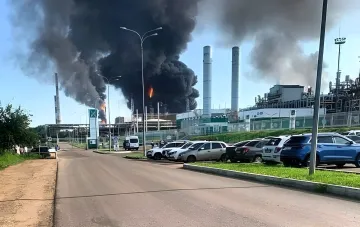
A more realistic option for pressuring Russian gas exports, experts say, is strikes on LNG terminals. Russia currently has five such facilities operating. Two of them — Vysotsk and Portova, located on the Baltic Sea — are already within the potential reach of Ukrainian drones. The large terminal complexes on the Yamal Peninsula are located significantly farther, but the growing range of Ukrainian UAVs is gradually closing this gap. Thus, even without attacks on international tankers, Ukraine has tools capable of dealing a significant blow to the infrastructure of Russian LNG exports and, consequently, to the revenues Russia earns from deliveries to Europe.