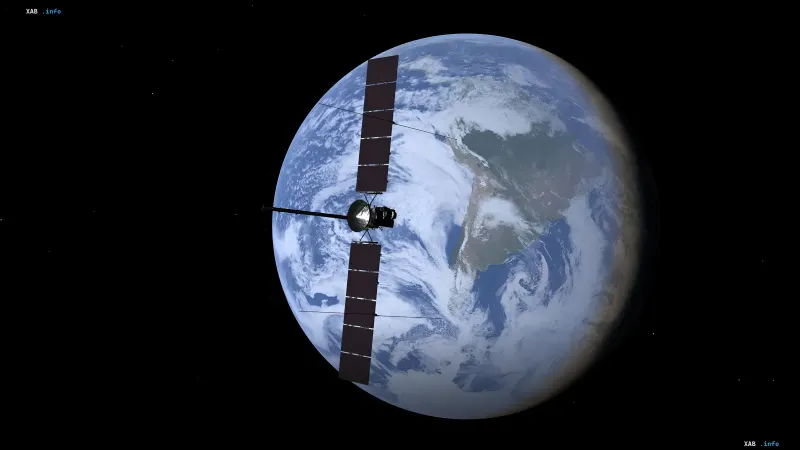
As it approaches a key mission milestone, NASA's Europa Clipper spacecraft is preparing for a gravitational maneuver near Earth, scheduled for December 3, 2026. At the closest point of its trajectory, the spacecraft will pass at an altitude of roughly 3,140–3,450 km above the planet's surface, with the closest approach occurring over a region west of Africa. This flyby is not a random episode but a precisely calculated element of the route: it is here that the spacecraft must gain additional speed to continue its multi-year journey to Jupiter without expending extra fuel.
Gravity as a Free Engine
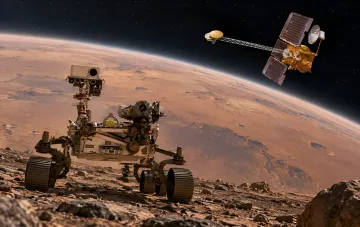
The essence of the maneuver is using Earth's gravity to accelerate the spacecraft. By passing close to the planet, Europa Clipper "picks up" a portion of its orbital energy, allowing it to increase speed and adjust its trajectory without burning its own fuel. This technique, known as a gravitational maneuver or "space catapult," is a standard tool of long-range interplanetary missions and is critical for saving fuel mass at launch. Notably, this is not the first such trick for the spacecraft: back in March 2025, Europa Clipper performed a similar flyby near Mars, using the red planet's gravity to adjust its orbit.
A Full Check of All Nine Instruments
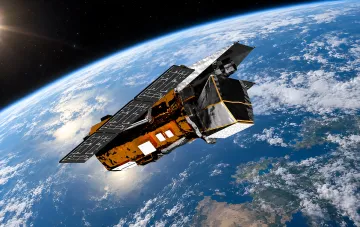
In addition to acceleration, the flyby near Earth becomes a full flight test of the scientific payload. During the maneuver, NASA specialists will switch on all nine of the spacecraft's scientific instruments to verify their functionality and calibrate the equipment before the start of the main research program. In particular, the magnetometer will measure Earth's magnetic field, while the E-THEMIS infrared camera will scan the planet's surface, which will confirm the correct operation of the observation system. The data obtained will serve as a baseline reference point: based on it, engineers will be able to distinguish real anomalies on Europa from instrumental errors.
The Mission's Goal — the Ocean Beneath Europa's Ice
The main task of Europa Clipper is the detailed study of Jupiter's moon Europa, beneath whose icy shell, according to prevailing scientific estimates, lies a vast ocean of liquid water. The spacecraft will study the thickness of the ice layer, the composition of the surface, and the geological features of the moon to assess whether conditions suitable for life could exist in its interior. Thus, every stage of the journey — from the Mars flyby to the Earth maneuver — is subordinated to a single goal: to deliver a functioning and calibrated set of instruments to the place where the answer to the question of possible extraterrestrial life is sought.
What's Next: the Path to Jupiter's Orbit
After the close approach to Earth on December 3, 2026, the spacecraft will continue its journey to Jupiter and, per the mission plan, is expected to enter its orbit in April 2030. Until then, the spacecraft will follow a calculated trajectory, and the data from the Earth maneuver will help confirm the system's readiness for long-term autonomous operation far from Earth. For the mission, this is, in essence, the last major "checkpoint" before the final stage — the direct study of Europa.