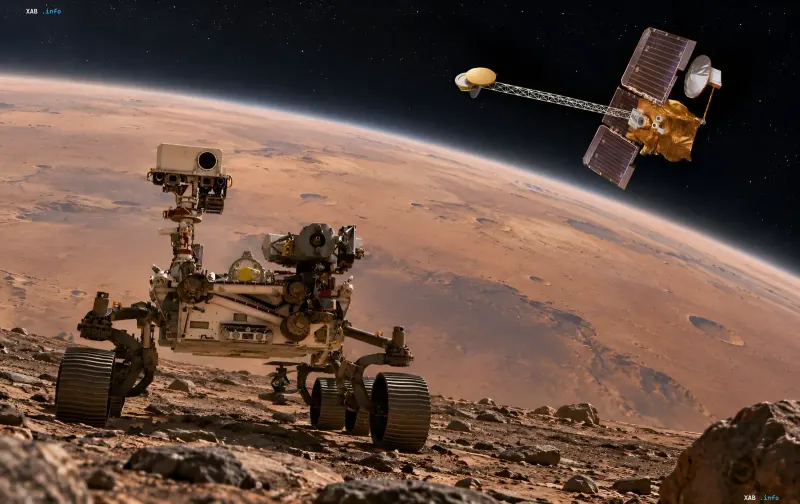
The American space agency NASA has temporarily suspended scientific operations on two of its Mars missions — the Perseverance rover and the Odyssey orbiter. The cause is a set of technical malfunctions that, according to experts, require time for diagnosis and recovery. In the rover's case, the issue is communication degradation, while the orbiter suffers from a more serious failure in its orientation system, threatening its operational capability in the medium term.
Perseverance: Loss of Contact and Switch to Safe Mode
On October 30, the Perseverance rover lost contact with Earth due to a malfunction in one of its two UHF radio stations. The system automatically switched to the backup channel, however, which transmits a signal twice as weak as the standard one. As a result, the rover entered safe mode, and NASA suspended scientific operations. Currently, Perseverance is transmitting data directly to Earth via the X-band system — a channel that works more slowly than communication through relay orbiters. Engineers at the Jet Propulsion Laboratory (JPL) are checking both UHF radio stations and attempting to restore the backup one in order to return to research by the end of November.
Sixth Year of Operation and a Distance Record
The rover has been working on the planet for six years, exploring the edge of an ancient lake and collecting rock and soil samples for potential delivery to Earth under the Mars Sample Return program. Last month, Perseverance traveled 45.16 km and broke the record for the longest distance traveled on another planet, previously held by the Opportunity rover. Thus, even amid temporary technical limitations, the rover remains one of the most productive assets in the history of planetary exploration.
Odyssey: Critical Failure of the Orientation System
An even more serious malfunction occurred on the Odyssey orbiter, which has been operating around Mars since 2001. In early November, one of its four reaction wheels (gyroscopes) responsible for the spacecraft's orientation stopped spinning. After a preliminary failure in 2013, Odyssey had only two working reaction wheels left. For stable operation, the orbiter needs at least three: they help point the solar panels at the Sun and the scientific instruments at Mars. Without them, the spacecraft is forced to use its hydrazine thrusters more often, and according to NASA estimates, in such a mode the fuel will last only 1–2 months. If the third reaction wheel can be restored, the reserves from careful use may last until the end of 2028. The team has already received the first positive results from diagnostics and continues testing.
What Is at Stake: The Relay Network and Future Infrastructure
Odyssey is one of four orbiters that relay data from the Perseverance and Curiosity rovers to Earth. This network also includes the Mars Reconnaissance Orbiter, the ExoMars Trace Gas Orbiter, and Mars Express. Losing another relay would significantly reduce the bandwidth and reliability of communication with the surface of Mars. Against the backdrop of these problems, in December NASA lost contact with the MAVEN spacecraft after 11 years of operation: it began to spin uncontrollably, and the exact cause has not been established — among the possible explanations are the effects of radiation or a software failure that led to incorrect orientation data.
Plan B: Blue Origin's Relay and the SkyFall Mission
To update its infrastructure, NASA ordered an orbital relay, the Mars Telecommunications Network, from the company Blue Origin, at a cost of up to 700 million dollars. It is planned to be put into operation in 2030, however, implementation of the contract has been suspended due to a complaint from a competitor — the company Rocket Lab. In addition, the SkyFall mission with three drone helicopters for aerial exploration of Mars is under consideration for 2028. Separately, the agency is working on replacing the high-resolution camera on the Mars Reconnaissance Orbiter, although this project currently has no approved budget or schedule. The combination of these steps shows that NASA is forced to simultaneously repair aging spacecraft and lay the foundation for the next generation of Martian infrastructure.