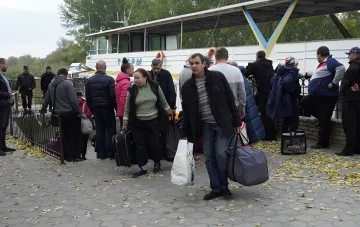
Another 23 citizens who had long been unable to leave the occupation on their own due to severe health conditions, lack of housing, and absence of relatives in government-controlled territory have been successfully evacuated from the temporarily occupied territories of Ukraine. This was reported by RBC-Ukraine, citing the Telegram channel of the Ukrainian Parliament Commissioner for Human Rights, Dmytro Lubinets. According to the Ombudsman, for many of those rescued, the decision to relocate took months to mature: "We had no one to go to, but staying was dangerous," he conveyed the words of the evacuated Ukrainians.
Family from Radensk: Oncology, Severe Heart Pathology, and Amputation
One of the telling cases was a family from the village of Radensk in the Kherson region, which long hesitated to move due to illnesses: the woman was diagnosed with oncology, the man with a severe heart pathology, and their relative underwent an amputation. The turning point was an enemy drone strike that destroyed their house: people sustained concussions, and upon returning, they were immediately sent to a medical facility, after which the decision to evacuate was made.
Caring for the Sick Amid Shelling and Without Communications
Specialists also evacuated a woman who in the occupied village single-handedly cared for a man with dementia and a bedridden elderly female relative amid constant shelling and a lack of communications. To call her son in government-controlled territory, she had to walk to the other end of the village to an acquaintance who had a generator. When the opportunity to leave arose, the woman asked to also help a lonely neighbor — as a result, everyone was taken to safety, and the family was finally reunited.
Why People Stay in Occupation and What Happens After Return
Dmytro Lubinets emphasized that people often remain in occupation not because they do not want to leave, but because they fear not coping upon return due to illness, age, lack of money, housing, or relatives. "That is why our work does not end with organizing the route," the Ombudsman noted. According to him, upon arrival, citizens are provided with temporary housing, sent for treatment and rehabilitation, and helped to restore documents and re-establish contact with loved ones.
Who Assists with Evacuation and How to Seek Help
The return was facilitated by the MHP company and its founder Yuriy Kosyuk, the International Committee of the Red Cross, the charitable foundation "Caritas Ukraine", as well as medics and social workers. The Ombudsman reminded that assistance with evacuation from temporarily occupied territories can be requested through the Ombudsman's Office via the hotline 1678, for calls from abroad — +38 (044) 299 74 08, or by writing from the occupation via WhatsApp, Viber, or Telegram at +3 073 719 81 34; the email [email protected] and the electronic cabinet are also operational.
Return of Children and Conditions for the Kinburn Spit Mission
Recall that on November 27, nine children returned to Ukraine from the occupation and Russia, having been in the temporarily occupied areas of Kherson, Zaporizhzhia, Crimea, and the Russian Federation. Among them is an eight-year-old boy who had not seen his mother since 2022, as well as an adult female alumnus of the Oleshky orphanage-boarding school. In total, since the beginning of the full-scale war under the Bring Kids Back UA initiative, 2,875 children have already been returned. At the same time, according to Lubinets, conducting evacuation measures in certain areas remains difficult: launching a humanitarian mission on the Kinburn Spit is not yet in progress, as it requires the Armed Forces of Ukraine to agree on a silence regime without compromising defense. Currently, the Ombudsman's office is focused on preparing humanitarian operations to evacuate civilians from the occupied territories of the Kherson and Zaporizhzhia regions.