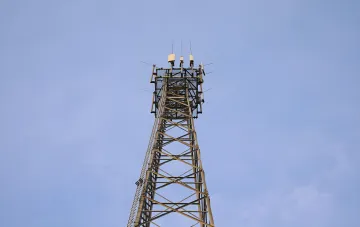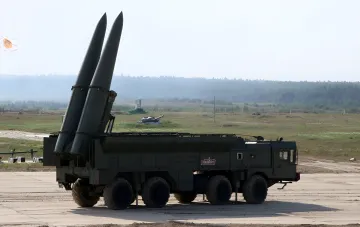
Last week, the public discourse was dominated by discussions regarding the so-called "electronic warfare (EW) dome" over Kyiv — a distributed network of EW systems designed to sever the connection between Iranian-made "Shahed" jet drones and their operators in Russia. In the RBC-Ukraine podcast "ETO BAZA" (THIS IS THE BASE), Contra-Drone co-founder Tymofii Yurkov analyzed in detail what this system actually represents, what threats it can neutralize, and where its capabilities reach their limit. According to him, the dome is not a panacea: it protects specific facilities, but cannot ensure total safety for the entire city.
What the EW dome is and how it has evolved
Yurkov specified that the dome was established over a year ago, yet its architecture has changed significantly since then. The number of EW systems surrounding Kyiv has more than tripled. This is a forced measure: the number of modules in the "Shahed" CRPA antennas is increasing, requiring ever more sophisticated suppression tools. The system works well against jet "Shahed" drones, cruise missiles, and any munitions that use satellite navigation for target correction. However, as the expert emphasizes, the dome is merely one layer of defense, not a standalone solution.
The Mathematics of Error: Why a 'Shahed' May Miss
The key mechanism of the dome is the suppression of satellite navigation. When the GPS/GLONASS signal is jammed, the drone switches to inertial navigation, which operates with a cumulative error. Yurkov provides a specific calculation: if a "Shahed" is jammed 25 km away from its target and its inertial system has an accuracy of about 1% (10 meters per kilometer), the error will be approximately 250 meters by the time it reaches the target. This means a strike intended for a bridge might hit water, or one for a power substation might strike a residential building. Thus, the dome protects specific objects from precision strikes but does not rule out accidental damage within the margin of error.
What the dome cannot stop: Ballistics and 'Rassvet'
Yurkov explicitly points to the limitations of EW defense. Ballistic missiles adjust their trajectory at high altitudes, before entering the dome's coverage area, and current suppression tools cannot reach that segment. A similar problem exists with the Russian "Rassvet" system—a threat that remains relevant for Ukrainian cities. In contrast, the dome is effective against most cruise missiles: it is enough to prevent a missile from "seeing" a one-by-one kilometer target square so that optical homing cannot lock onto the target. If the error exceeds two kilometers, a hit is almost impossible even with final video-based guidance.
Mesh networks, beacons, and the speed problem
A separate part of the conversation concerned the connection between "Shahed" drones and operators via mesh networks. According to Yurkov, mesh connections are almost entirely jammed in Kyiv. The threat remains outside the city — for trains, convoys, and other targets in zones with fewer EW and detection capabilities. A more complex task is navigation via beacons, which can use different frequencies every time, unlike GPS with known L2 and L5 frequencies. As long as the beacon's parameters are not determined, suppression is difficult; once frequencies and rough locations are identified, jamming becomes possible. The most reliable way to counter beacons is physical destruction.
Prospects: 100 km suppression and enemy tactics
Contra-Drone is developing tools capable of suppressing CRPA antennas at a distance of up to 100 km. This will allow the sky over Kyiv to be covered with a margin and increase targeting error to 2–3 km, rendering "Shaheds" incapable of both terrorism and precision strikes on objects. Yurkov predicts that under such conditions, the enemy will either switch to other guidance methods or cease using "Shaheds" and missiles with CRPA. Regarding target speed—the enemy claims plans to accelerate "Shaheds" up to 1000 km/h—the speed of the object does not matter for the EW tool itself, as radio waves travel at the speed of light. The critical factor is response time: at ultra-high speeds, only minutes remain for suppression, requiring threat detection while still over enemy territory.