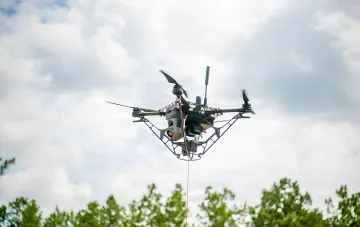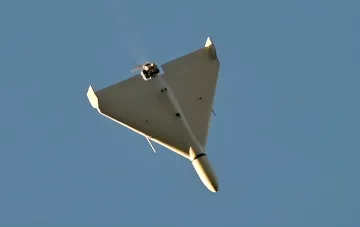
Electronic warfare (EW) remains one of the key elements in defending Ukrainian military forces and civilian infrastructure from Russian drones and missiles. However, according to Tymofiy Yurkov, co-founder of the company Contra-Drone, who in an interview with RBC-Ukraine gave a detailed breakdown of the current challenges, the adversary is systematically changing its tactics: increasing the number of channels in the navigation antennas of UAVs, switching to fiber-optic control channels, developing automatic terminal guidance using artificial intelligence, and employing jet-powered modifications of the Shahed. All of these factors directly affect the effectiveness of existing EW systems and require a reassessment of the defense architecture, particularly around the perimeter of critical infrastructure.
The evolution of CRPA antennas: from simple GPS to 20-channel systems
One of the most significant trends, as highlighted by Yurkov, is the gradual increase in complexity of the navigation modules in large drones, primarily in the Shahed. At the start of the full-scale war, such UAVs used ordinary GPS antennas, which could be jammed with standard electronic noise at the corresponding frequency. Then CRPA antennas (Constantly Reconfigurable Phase Array) appeared — first four-module, then 8-channel, 12-channel, and 16-channel systems. According to Contra-Drone, at present the Russians have purchased large batches of 20-channel GNSS navigation systems from China. In the expert's assessment, this directly affects the construction of a defensive perimeter around energy facilities: to counter such systems, it is necessary to increase the number of navigation jamming assets and create large multi-module complexes around energy objects capable of "pushing through" the navigation channels of missiles, KABs, and Shahed-type UAVs alike.
Fiber-optic drones and AI terminal guidance: threats that are changing the rules of the game
The second key direction in the adversary's evolution, as named by Yurkov, is the growing use of fiber-optic UAVs. The fundamental difference of such drones is that the fiber-optic control channel cannot be subjected to electronic jamming — traditional EW means are powerless here. At the same time, such vehicles have significant drawbacks: due to the presence of a cable, they are heavier, slower, and less maneuverable, and the cable itself can be severed. The third threat the expert named is the use of artificial intelligence for the automatic terminal guidance of FPV drones onto vehicle targets. In such a scenario, the operator first acquires the target, after which the drone continues guidance autonomously. After control is handed over to the AI, EW may lose its effectiveness, although, according to Yurkov, such cases are not yet widespread: the terminal guidance system still has significant shortcomings and often loses the target, especially when a vehicle is moving across terrain without distinct visual contrast. "The system is not yet sufficiently developed, but we see significant changes and understand that it will continue to develop," emphasized the co-founder of Contra-Drone.
Optical detection as a complement, not a replacement, for EW
In response to fiber-optic and AI-controlled drones, Contra-Drone is developing an optical detection means for such targets. According to Yurkov, this complex was already presented at the "Defense of Ukraine" exhibition (DNV-1) and is currently undergoing testing. It is fundamentally important that this means is not autonomous: it will be used exclusively in conjunction with vehicle-mounted EW. "In other words, EW is not going anywhere," the expert emphasized. The optical means is intended to compensate for the fact that against skilled operators actively maneuvering at short range, interception remains difficult. By contrast, a fiber-optic drone in most cases moves in a more linear fashion, as do UAVs that have switched to automatic guidance using AI. "If the drone is moving linearly, as happens in most cases with fiber-optic or in almost all cases with artificial intelligence, the system is able to detect and destroy it in time," explained Yurkov. At the same time, he stressed that EW does not lose its significance: its effectiveness is especially noticeable at large distances between the UAV operator and the target, in particular at ranges beyond 7–10 km.
Impact on ballistics and KABs: where EW works and where it does not
Alongside the main interview, RBC-Ukraine published an additional article in which EW developers explain why ballistic missiles and guided aerial bombs (KABs) represent a different category of task compared to drones. Unlike UAVs, which fly at low altitude along a predictable trajectory, ballistic and aeroballistic missiles spend a significant portion of their trajectory outside the range of ground-based EW systems. Nevertheless, according to Ukrainian specialists, Ukraine retains the ability to affect the navigation channels of such targets over certain segments of flight, which requires the creation of precisely those multi-module jamming perimeters that Yurkov spoke about in the context of protecting energy facilities.
Contradictory data
No significant discrepancies in figures or chronology were found in the provided sources. At the same time, it should be noted that the information on the purchase of 20-channel CRPA systems in China was conveyed by Yurkov in the phrasing "according to our information," which indicates an intelligence or analytical source rather than a publicly confirmed fact. In addition, the assessment of the frequency of AI terminal guidance use ("not yet frequent") and the effectiveness of the optical complex, which is "undergoing testing," are expert judgments rather than recorded statistical data. Thus, both positions — about the growing threat and about the sustained effectiveness of EW — are consistent and complementary, forming no direct contradiction.