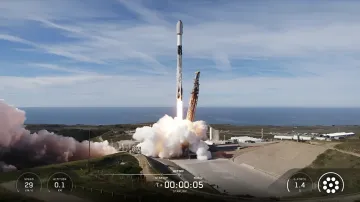
On Friday, a tense drama unfolded at the Starbase launch site in Texas: the launch of the third version of the Starship rocket (Flight 13 mission) was canceled just seconds before liftoff. The automatic safety system aborted the procedure after detecting a critical malfunction in the Super Heavy booster's engines. As Elon Musk reported on the X platform, a new attempt will not take place until next week at the earliest.
Perfect preparation and a last-minute failure
Throughout the day before the launch, ground operations ran without a hitch. Engineers successfully completed the ultra-complex process of refueling the two-stage system. More than 5.2 million kg of cryogenic liquid methane and oxygen were loaded into the tanks. However, when the timer reached zero and the water deluge system began flooding the launch mount to dampen the thermal and acoustic waves, a failure occurred.
The flight control computer complex immediately initiated the abort procedure. Graphic indicators on the official broadcast confirmed the cause: out of the 33 powerful Raptor 3 engines installed on the Super Heavy booster, four units failed to ignite during the staged ignition phase.
Technical context: lessons from previous flights
This flight was intended to be the second test of the updated Starship Version 3 design and third-generation engines. Engineers modified the launch algorithms in an attempt to correct errors identified during the May Flight 12 mission. At that time, despite the successful landing of the upper stage, serious issues were recorded:
- Flip maneuver failure: A microscopic delay in engine ignition caused the Super Heavy booster to deviate 90 degrees from its trajectory.
- Braking problems: During the simulated landing attempt, some engines failed to relight for the braking impulse, resulting in an emergency splashdown.
- Premature shutdown in orbit: One of the Starship vehicle's engines shut down early, leading to the cancellation of the in-vacuum relight test.
The Flight 13 mission planned to test the robustness of algorithms against transient fluctuations and pave the way for the booster's return directly to the launch tower. However, the failure of four engines at liftoff jeopardized the completion of these tasks.
Strategic importance of the mission
The success of the launch is critical for SpaceX's long-term plans. For the first time, the spacecraft carried upgraded Starlink V3 satellites. Although they were scheduled to burn up in the atmosphere 20 minutes after deployment, this flight was meant to prove the viability of the "orbital data center" concept. Indeed, commercial satellite launches remain the company's only consistently profitable business segment.
Furthermore, achieving flight stability for Starship V3 is a decisive step for future in-orbit refueling tests and preparing the spacecraft for lunar missions under NASA's Artemis program.