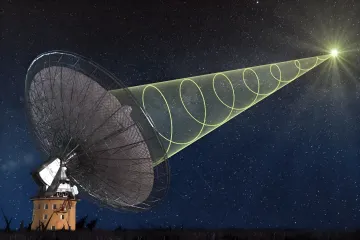
While testing new software on archival data from the world's largest single-dish radio telescope, FAST, a team of astronomers discovered an unusual narrowband radio signal originating from the direction of the K2-155 star system, located approximately 238 light-years from Earth. Designated NBS 260108, the signal was captured in data collected on September 10, 2021, as part of an observational series that also included the stars K2-18, GJ-9066, and Ross 128. At the time of discovery, the source of the emission remains unidentified: researchers emphasize that detecting an anomalous signal and determining its nature are fundamentally different tasks.
Characteristics of the NBS 260108 Signal
Scientists highlighted several features that make NBS 260108 a subject of close scrutiny. First, the signal appeared exclusively in the receiving beam pointed at K2-155 and was not detected in any of the 18 other beams simultaneously monitoring neighboring patches of the sky. Second, the frequency of the signal gradually drifted toward lower radio frequencies, which appeared on graphs as a thin, slightly sloped stripe. Third, the signal clearly manifested in the YY polarization channel with a signal-to-noise ratio of about 23, while it was absent in the XX channel; after combining data from both channels, the signal-to-noise ratio was approximately 15. Such narrowband characteristics are rarely produced by natural cosmic processes, according to researchers, but are typical of artificial transmitters, making the signal a candidate for further analysis under the Search for Extraterrestrial Intelligence (SETI) program.
The K2-155 Star System and Planet K2-155d
The K2-155 system contains three super-Earths—planets larger than Earth but smaller than ice giants like Neptune and Uranus. Of particular interest to the SETI program is the planet K2-155d: it is located near the zone where liquid water could theoretically exist on the surface, has a radius approximately 1.6 times that of Earth, and completes a full orbit around its star in 40.7 days. The coincidence of the signal's direction with the position of a potentially habitable planet heightens scientific interest in NBS 260108, although the study's authors explicitly state that it is currently impossible to claim a link between the signal and any specific planet in the system.
FAST Telescope Capabilities and Observation Methodology
The FAST (Five-hundred-meter Aperture Spherical radio Telescope) radio telescope is installed in a natural depression in southwestern China. Its diameter is about 500 meters, and its collecting surface area is equivalent to roughly 30 football fields, allowing it to capture extremely weak radio waves from deep space. The observation of K2-155 was conducted as part of a series that also included K2-18, GJ-9066, and Ross 128. When analyzing the same data, researchers recorded other narrowband radio signals, but their characteristics differed significantly: for K2-18 the signal was extremely weak, for GJ-9066 the frequency remained practically unchanged, and for Ross 128 the anomaly appeared at a different frequency. This variety of profiles complicates the unambiguous interpretation of each signal.
Plans for Further Verification
To more accurately determine the origin of NBS 260108 and rule out interference generated by terrestrial equipment or known technologies, scientists plan to compare the raw recordings from all 19 telescope beams. Only after such cross-verification will it be possible with a greater degree of certainty to attribute the signal either to a cosmic source or to local interference. Currently, none of the researchers claim that NBS 260108 is a sign of extraterrestrial technology; the signal is viewed as an anomaly requiring additional observation and analysis.