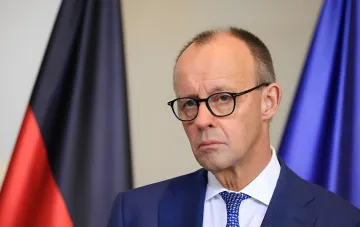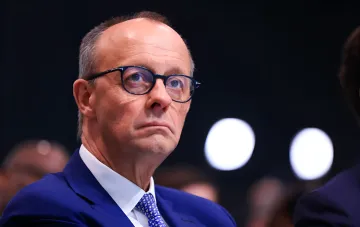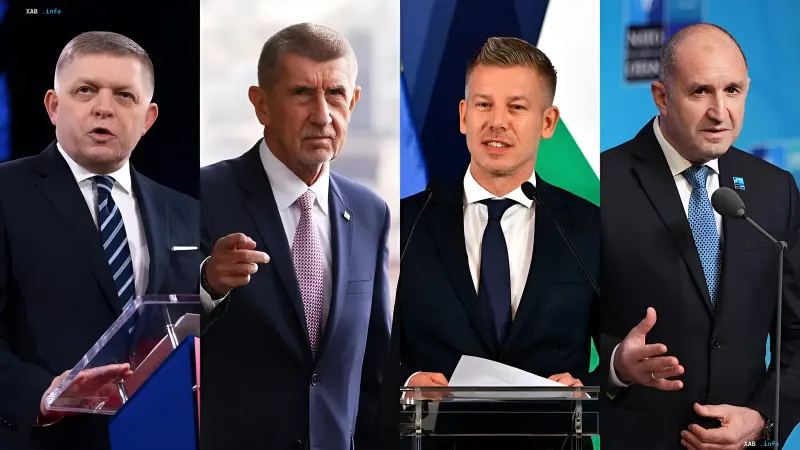
A new standoff has erupted in Brussels and EU capitals over the community's long-term budget for 2028–2034. German Chancellor Friedrich Merz, having sent a letter to European Council President António Costa, has effectively conditioned the adoption of the new EU multiannual financial plan on the willingness of all member states to commit to long-term financial support for Ukraine. According to him, providing new aid to Kyiv is a "necessary prerequisite" for budget approval. Four nations—Slovakia, the Czech Republic, Hungary, and Bulgaria—immediately responded, publicly declaring the linkage unacceptable and threatening to use their veto power.
Berlin's ultimatum: the letter to Costa and the logic of "indivisible security"
In the letter made public early this week, Merz argued that "supporting Ukraine is a matter of our common, indivisible European security, and therefore the burden of this support must be shared by everyone." Thus, the German Chancellor linked two fundamentally different issues, each requiring unanimous approval within the EU: the approval of the multiannual budget and the funding mechanism for Ukraine. Brussels, in turn, has already promised to cover two-thirds of the expected 70-billion-euro budget deficit for Ukraine—roughly 45 billion—via a mechanism yet to be determined. Experts consider the issuance of new joint debt instruments the most likely option, which would supplement the current 90-billion-euro credit support package from which Slovakia, the Czech Republic, and Hungary were previously exempted.
Fico: "Our votes are equal"
Slovak Prime Minister Robert Fico responded most sharply to Merz's initiative. On Tuesday, while meeting his Czech counterpart Andrej Babiš in Bratislava, he called the German Chancellor's actions a "classic example of blackmail," which he "rejects." "In this matter, our votes are equal," Fico declared. "If Mr. Merz talks about the possibility of using a veto, I can say exactly the same. We have the same authority to impose a veto as the Federal Chancellor of Germany." The Slovak PM emphasized that his country is sovereign and maintains its own position, adding: "Today, everything will go not as it usually does. Today we must stand up to blackmail."
Babiš and the timing issue: 100 billion arriving too late
Czech Prime Minister Andrej Babiš ironically noted that Merz "likely does not realize" that the proposed EU budget already includes 100 billion euros for Ukraine. However, as Babiš pointed out, these funds will only become available by 2028, whereas Kyiv will face a 70-billion-euro budget deficit as early as next year. Thus, even with funds formally present in the multiannual plan, they do not solve Ukraine's current financial problem, which, in Prague's view, makes Berlin's ultimatum not only politically but also practically unconvincing.
Magyar and Radev: debt ceiling as an argument
On Tuesday, just two days after Merz's letter was published, the Chancellor received Hungarian Prime Minister Péter Magyar in Berlin. Following the bilateral meeting, Magyar clearly outlined Budapest's position: linking the EU budget to Ukraine aid is unacceptable because these are fundamentally different issues. "It is quite possible that politics are involved here. I wouldn't call it blackmail—I avoid such words in general, because in the modern world everything is interconnected," he noted, commenting on Fico's remarks. "However, in my opinion, such an approach can hardly be called a good signal." Magyar explained that Hungary cannot take on new debt obligations at the EU level as it is struggling to contain its own growing state deficit, and promised to continue negotiations in Berlin, Dublin, and Brussels. Bulgarian President Rumen Radev presented similar logic while speaking in Varna: high budget deficit levels make it impossible for Sofia to participate in new Ukraine lending programs. At the same time, Radev emphasized that Bulgaria will continue to provide support through other means—in particular, through energy supplies—and "is in no way blocking decisions made at the EU Council level."
Context: "Friends of Cohesion" against the "frugals"
The four countries opposing Merz's initiative are part of the informal "Friends of Cohesion" group—a group of 17 states insisting on preserving funding for cohesion policy and agricultural subsidies in the EU long-term budget. This puts them in direct conflict with so-called "frugal" countries, including Ukraine's largest donors, primarily Germany. Berlin is annoyed that Bratislava, Prague, Budapest, and Sofia, on one hand, demand funding under cohesion policy, while on the other, attempt to evade additional obligations to support Kyiv. This contradiction is essentially the basis of Merz's ultimatum: by the Chancellor's logic, the right to maintain cohesive funding must be accompanied by a readiness to bear security costs. Now, the key question for Brussels is whether this knot can be untied before the dispute escalates into a full-scale institutional crisis over the adoption of the budget for the new seven-year period.