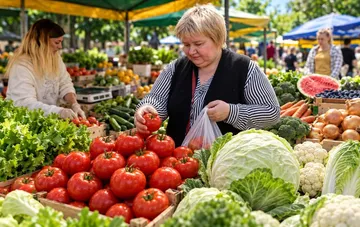
Following the completion of the active harvesting campaign, the usual seasonal turning point is beginning on the Ukrainian food market: prices that dropped at the peak of harvesting are starting to reverse upwards. According to the Ukrainian Agribusiness Club (UCAB), the average retail price of potatoes in September was UAH 15.17/kg, and in October it rose to UAH 17.23/kg — an increase of 13.6% in a month. Compared to last October, the cost has increased by approximately 11%. Maksym Hopka, head of the analytical department at UCAB, explains that this dynamic is traditional: after mass harvesting concludes, the volumes of produce available for immediate sale decrease, and part of the harvest is placed in storage, which automatically raises producers' costs.
Baseline scenario: potatoes up to UAH 23/kg, vegetables show mixed trends
Under the UCAB baseline scenario, assuming no significant product losses during storage, the average retail price of potatoes could reach approximately UAH 19–23/kg by the end of the year. The situation with borscht-set vegetables is currently mixed: in October compared to September, cabbage went up in price by 10.6% and beets by 14.4%, while carrots decreased in price by 10.3%, and the price of onions remained practically unchanged. Analysts point out that the cost of individual crops depends not only on seasonality, but also on the quality of the harvest and storage capabilities.
Where price increase risks are highest: dairy, eggs, bread, and greenhouse vegetables
With the transition from selling freshly harvested produce to sales from storage facilities, producers' costs are growing, and amid unstable energy supplies, this curbs any generalized price reduction. Experts expect that prices will continue to rise until the end of the year, but unevenly. The highest risks of price increases are seen in the segments of chicken eggs, dairy products, bakery items, and greenhouse vegetables. According to an assessment by the Association of Milk Producers, by the end of 2026, fresh dairy goods — milk, kefir, sour cream, yogurts — may rise in price by 20–25%, while a more moderate growth within 5–10% is expected for cottage cheese and butter. Additional pressure is created by increased costs for fertilizers, fuel, electricity, feed, packaging, and logistics, as well as attacks on infrastructure.
"Black swans" and market balance: the main safeguard against a sharp spike
Oleh Pendzin, a member of the Economic Discussion Club, emphasizes that overall, an excess of supply remains on the market, and pricing depends entirely on the balance of demand and buyers' purchasing power. He calls the uncertainty factor — the so-called "black swans" — the key risk to the projected scenario: repeated massive shelling of critical energy infrastructure or logistics centers. In the absence of force majeure, he says, market balance acts as the main safeguard against a sharp price increase: any price on the shelf is the ratio of supply and demand.
No deficit expected: food surplus due to restricted exports
Pendzin notes that there are significant issues with the population's solvent demand, as citizens' real incomes are not growing, and forecasts: "Practically across all positions there will be price growth, and somewhere, conditionally, in May of next year, you and I will see a reverse seasonal process that will start pushing prices back down." At the same time, specialists point out that Ukraine retains a huge food surplus due to limited export opportunities through sea ports, so there are no prerequisites for a deficit or extreme price spikes due to a lack of goods. Thus, until the end of 2026, consumers should expect a moderate but uneven rise in prices for certain food categories without the risk of an acute deficit.