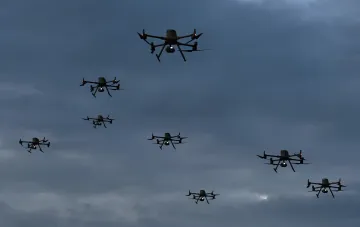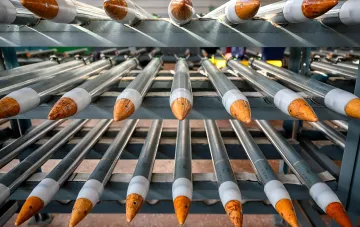
For several days in a row, Russia has been striking Kyiv and the Kyiv region with jet-powered strike drones, forcing Ukraine's air defense to operate at the limits of its capabilities. Against the backdrop of these attacks, the Ukrainian Ministry of Defense confirmed that four types of high-speed interceptors, developed specifically to counter jet-powered UAVs, have already been tested in the country. Defense Minister Hennii Humenyuk stated that the production of these systems is planned to be scaled up to thousands of units, while President Volodymyr Zelenskyy set the task of raising the interception rate of jet-powered Shaheds above 90 percent by autumn.
Alexa Spatium: the first jet-powered interceptor in the AFU arsenal
In August 2026, the Ministry of Defense announced the addition of the Alexa Spatium UAV to the arsenal of the Defense Forces — a high-speed jet-powered interceptor developed by Ukrainian engineers. The manufacturer has not been officially named. The drone is capable of destroying small air, surface, and ground targets in real combat conditions, including the Russian jet-powered Geran-3, Geran-4, and Geran-5. Alexa Spatium is equipped with a turbojet engine, operates at low and medium altitudes, and its warhead can be fragmentation-blast, shaped-charge, or thermobaric. The machine's dimensions are approximately 1.5 by 1.7 meters, and it is launched from a mobile catapult within a few minutes. Thanks to its composite airframe, the drone performs sharp maneuvers without losing controllability, and in the event of a failed mission it is capable of returning to the launch site and being reused.
STING and Jetkiller: speed as the main weapon
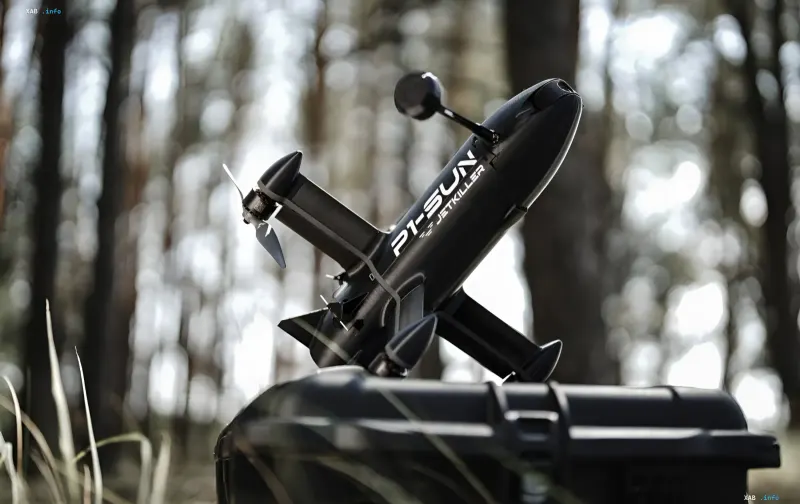
In late August, against the backdrop of ongoing attacks on Kyiv, the company "Wild Hornets" published footage of jet-powered Shaheds shot down by the STING interceptor. The machine's top speed is 280 km/h, with a service ceiling of 7,000 meters. On August 18, pilots of the SBU's "Alpha" Center of Special Operations set a record: a Shahed was shot down at an altitude of 6,955 meters. Among the recently confirmed successes is the crew of "Merzotnyky" of the 435th Separate Unmanned Systems Division, which shot down two more jet-powered drones last week. In parallel, the Ukrainian company SkyFall presented a modified P1-SUN Jetkiller interceptor at the Farnborough airshow, created in response to the emergence of high-speed Shaheds with engines capable of reaching 500 km/h. The new version accelerates to 370 km/h (compared to 310 km/h for the previous model) and has already undergone combat testing, destroying more than a dozen jet-powered targets. Serial production was planned for August 2026.
ZIRKA: artificial intelligence in the guidance system
The fourth interceptor, ZIRKA, is capable of destroying high-speed and maneuverable targets, in particular jet-powered drones of the Geran-4 type, at speeds of up to 340 km/h. The development was carried out by the company NOCTIS with the support of Vyriy Industries, while the technical requirements were formulated jointly with the Darknode unit, which has real combat experience in destroying enemy UAVs. On board is a mini-computer with artificial intelligence algorithms trained on a dataset of real interceptions. The system independently analyzes the video stream, detects and tracks the target; the operator only needs to confirm the lock and adjust the speed for a smooth approach. After confirmation, the drone guides the target automatically, correcting the flight trajectory dozens of times per second.
Strike on Bucha district and Kyiv's strategic response
On the evening of August 28, 2026, Russia struck warehouses in the Bucha district of the Kyiv region with drones, causing a large-scale fire and the detonation of ammunition in the village of Mila. The number of fatalities reached 37, among the victims was Taras Dydych, the head of the Dmytrivska hromada. Residential houses and a pension home for the elderly were damaged. It was against the backdrop of this tragedy that Zelenskyy publicly set the target of intercepting more than 90 percent of jet-powered drones by autumn, while Humenyuk confirmed that all four interceptors had passed testing and were ready for serial production.
Contradictory data
Open sources contain minor discrepancies in the specifications of the interceptors. For example, the description of the Jetkiller lists a speed of 370 km/h for the new modification, whereas some publications cite a figure of 340 km/h, which most likely refers to the previous version or to interim testing. Similarly, the STING's service ceiling is stated at 7,000 meters, yet the recorded combat record stands at 6,955 meters — the 45-meter difference may be explained by the distinction between theoretical and practical ceiling. In addition, in the Ministry of Defense's materials the manufacturer of the Alexa Spatium is not disclosed, whereas the companies behind the other three systems are clearly named. This creates an information vacuum that may be filled as official data becomes available.