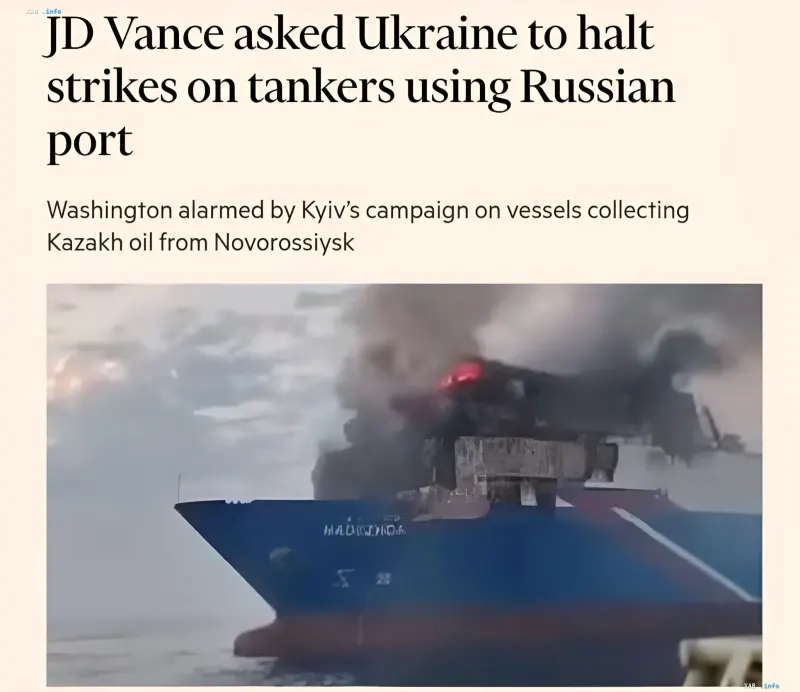
Diplomatic Intervention: Vance's Call to Zelenskyy
Amid global tensions and ongoing hostilities, August 12, 2026, marked a significant diplomatic development that could impact global energy market stability. According to the authoritative publication Financial Times, Ukraine has officially suspended drone (UAV) strikes on tankers and port infrastructure near the Caspian Pipeline Consortium (CPC) terminal in Novorossiysk. A key factor influencing this decision was a personal appeal from US Vice President JD Vance to Ukrainian President Volodymyr Zelenskyy.
Telephone negotiations took place on July 31, 2026. During the conversation, the American side expressed serious concern regarding the safety of facilities critical for transporting Kazakhstani oil to global markets. Vance emphasized that damaging the terminal or the tanker fleet carrying non-Russian oil could trigger unpredictable instability in global energy and directly harm the financial interests of American corporations holding significant stakes in these projects.
Economic Context: Why is the US so interested in the CPC?
The Caspian Pipeline Consortium is not just a logistical artery but a strategic asset linking Central Asian resources with global consumers. Significant shares in the project, as well as in the fields being developed in western Kazakhstan (specifically the giants Tengiz and Karachaganak), belong to major American energy giants. This creates a direct financial interest for Washington in maintaining the uninterrupted operation of the infrastructure.
Analysts note that the CPC accounts for up to 1.2% of the world's oil supply. In a context where energy security is a top priority on the international agenda, any disruption in this route could cause sharp spikes in raw material prices. This is why the US, through its representatives, insisted that the Ukrainian side exclude CPC facilities from the list of targets, especially considering that part of the transported raw materials is of American origin.
Ceasefire Conditions: What is allowed and what is forbidden?
According to sources cited by the Financial Times, the Ukrainian side agreed to observe restrictions, but only under clearly defined criteria. This is not a complete refusal to strike Novorossiysk port infrastructure, but rather a targeted exemption. The ban on attacks applies exclusively to CPC facilities and vessels flying the flags of third countries that are not subject to Ukrainian sanctions and are not transporting products of Russian origin.
Representatives of Ukrainian relevant ministries confirmed the fact of consultations with American partners, noting the creation of corresponding coordination mechanisms. Kyiv emphasizes that this decision is dictated not only by diplomatic pressure but also by the need to consider the interests of international energy security. However, as experts note, this creates a complex task for intelligence and the military: it is necessary to identify vessels and facilities with high precision to avoid violating agreements while continuing to exert pressure on the Russian economy.
Hidden Motives and Military Technologies
The expert community is actively discussing the hypothesis that Ukraine's compliance with these conditions may be linked to broader agreements. In particular, there is talk of possible discussions regarding licensing agreements for the localization of air defense (PVO) production on Ukrainian territory. Although there is no official confirmation of this link from Washington or Kyiv yet, many analysts see this as a logical step: exchanging tactical concessions in one sphere for technological support in another.
The White House, the US State Department, and the Vice President's office have not provided official comments on this issue at the time of publication by independent agencies. However, the fact of a high-level call and Kyiv's subsequent reaction indicate that the dialogue is taking place at the highest level and is yielding concrete results.
Contradictory Data
Despite the general clarity of the situation, there are certain discrepancies in the details among sources. Some independent observers point out that Kyiv's official statements about "coordination mechanisms" may be merely formal, and real restrictions may be less strict than reported in the press. Furthermore, there are questions regarding exactly how compliance monitoring will be carried out: whether through the exchange of intelligence or through international observer missions. For now, these questions remain open, and the situation may develop unpredictably.