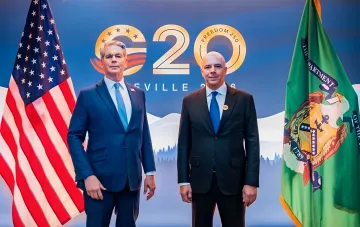
On the sidelines of the meeting of G20 finance ministers and central bank governors held in Asheville (North Carolina, USA), US Treasury Secretary Scott Bessent held a bilateral meeting with Russian Finance Minister Anton Siluanov. According to Reuters, citing sources familiar with the course of the negotiations, the American official directly conveyed to the Russian side that expanding economic cooperation between the two countries is impossible while the war against Ukraine continues. In effect, Washington has made any deepening of the financial and economic dialogue contingent on a cessation of hostilities.
Washington's position: peace first, then economics
According to the agency's sources, during the conversation the two sides discussed US President Donald Trump's peace plan for resolving the conflict. As Reuters reports, when Siluanov tried to steer the discussion toward issues of mutual economic interest, Bessent, according to one source, stopped him and stated: “Nothing is possible until the war ends.” This phrase, in essence, became the main outcome of the meeting and recorded Washington's hardline position: economic incentives and new agreements will not be considered as a tool of pressure or reward until a cessation of the war is achieved.
How the Russian side presented the outcome
The Russian Finance Ministry viewed the meeting in a more neutral light. There, officials stated that during the conversation the two sides discussed financial cooperation within the G20 framework, without emphasizing the condition tied to ending the war. The Russian side, by its own account, regarded the talk as part of routine interaction in the “Group of Twenty” format, while American sources stress that the conversation was primarily about tying any economic steps to a peaceful settlement.
Contradictory data
Here there is a clear difference in how the two sides present the same events. According to Reuters, Bessent flatly refused to expand cooperation and blocked Siluanov's attempt to move to issues of mutual interest, uttering the phrase “Nothing is possible until the war ends.” The Russian Finance Ministry, by contrast, characterizes the meeting as a discussion of financial cooperation within the G20 framework, without emphasizing the ultimatum-like nature of the US position. Thus, one side sees in the conversation a clear condition regarding Ukraine, while the other sees a routine interdepartmental dialogue in summit format. The difference in interpretation is positional in nature: the fact of the meeting and its holding is confirmed by both sides, but assessments of its content and tone diverge.
Context: Siluanov's first in-person participation since the start of the invasion
Reuters separately notes that the meeting in Asheville marked the first instance of Siluanov's personal participation in a G20 event since the start of Russia's full-scale invasion of Ukraine. Prior to this, the Russian side had not sent its finance minister to “Group of Twenty” meetings in person. The very fact of Siluanov's presence and Washington's willingness to hold a bilateral meeting with him, albeit with a hardline message, indicates that channels of financial dialogue at the G20 level are maintained, but remain strictly limited by a political condition — the end of the war.
The outcome of the negotiations in Asheville was the entrenchment of a principle under which economic support and new agreements with Russia are frozen until the conflict ends. For Moscow, this means that within the G20 it will not be able to obtain additional economic concessions, while for Washington it is a demonstration that the economic instrument remains subordinated to the goal of a peaceful settlement.