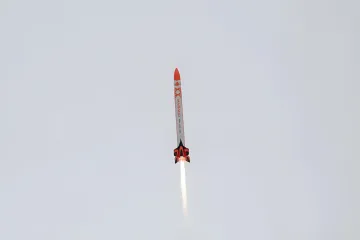
Geespace, a subsidiary of the Chinese automotive conglomerate Geely Holding Group, has received from China's Ministry of Industry and Information Technology (MIIT) permission to conduct two-year trials of its own orbital constellation of communications satellites. According to South China Morning Post, this is evidenced by a corresponding notice published on the ministry's official website. The license, issued in August 2026, makes Geespace the first private company in China to be granted the right to test such satellite infrastructure.
From assembly lines to orbital constellations
Geespace was founded in 2018 as a specialized division of Geely Holding Group with a single strategic goal — to build an orbital constellation of communications satellites capable of transmitting data at minimal cost. Between 2022 and 2025, the company launched 64 satellites across six launches, thereby completing the first phase of its constellation deployment. The ultimate goal of the ambitious project is to exceed the mark of 5,600 communications satellites in orbit. Geespace is already cooperating with telecom operators in more than 20 countries across Asia, Latin America, the Middle East, and Africa.
A license for the private sector: a precedent for China
Geespace's satellite network is designed for data exchange via terminals installed on vehicles of all kinds — automotive, rail, and maritime. For the first time in China, such a license has been issued to a private company. A precedent for the state sector was recorded in May 2026, when a similar license was granted to Beijing Guodian High-Tech Technology, which is backed by the state telecom giant China Mobile. Thus, the regulatory framework for satellite communications in China is taking shape along a two-tier model: state operators first, then private players.
A "not like Starlink" strategy: a bet on IoT and broad coverage
The technical philosophy of Chinese satellite systems differs fundamentally from SpaceX's Starlink approach. While Starlink is oriented toward high-speed data delivery for end users, Chinese systems, including Geespace, are tuned for low terminal power consumption and maximally broad geographic coverage. Such infrastructure in China is viewed primarily as a component of the Internet of Things (IoT) ecosystem, where billions of connected devices require a stable, albeit not high-speed, communication channel. Experts expect other Chinese telecom operators to follow Geespace's lead, as there will be room in the IoT connectivity market for everyone.
The satellite IoT market is growing at double-digit rates
According to the research firm ABI Research, at least 13.6 million devices used satellite connectivity for Internet of Things purposes in 2025, a 20.7% increase over the previous year. By 2030, the same agency forecasts that this figure will more than double — to 28.6 million devices — while the segment's associated revenue will reach $3.1 billion. In this context, the two-year testing license obtained by Geespace looks less like a regulatory formality and more like a signal that China's private space sector is entering an advanced stage of commercialization.