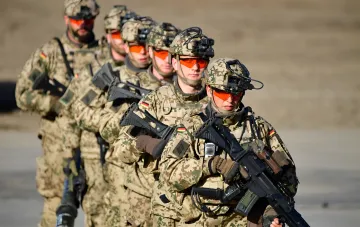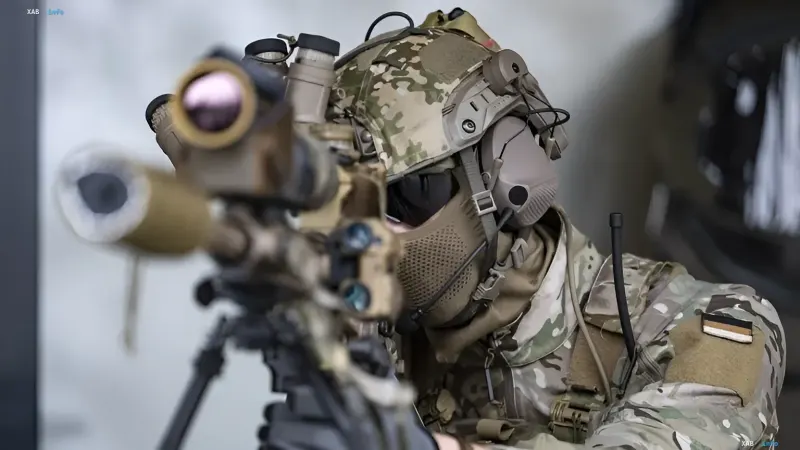
The commander of the Bundeswehr's elite special operations unit, Kommando Spezialkräfte (KSK), has publicly stated that his subordinates are preparing for a potential large-scale war with Russia. The message, published on October 26, came from KSK Commander Brigadier General Andreas Kühne and marks a notable shift in the rhetoric and training doctrine of the German special forces, which have traditionally positioned themselves as the equivalent of the British SAS or the US Green Berets.
Rebuilding training for a Russian adversary
According to General Kühne, the KSK is adjusting its training program to account for the characteristics of a hypothetical enemy: the units are practicing operations against Russian forces equipped with tanks, artillery, unmanned aerial vehicles, and electronic warfare systems, including in extreme sub-zero temperatures. "We are paying special attention to our adversary, Russia," the commander emphasized, pointing out that the profile of a heavily armed Russian opponent has become the starting point for changing training objectives.
Preparedness for a protracted conflict
General Kühne also stated that special forces soldiers must be prepared to "remain on the battlefield much longer," or in his phrasing, "infinitely," if a war breaks out. Separately, he noted that the unit was preparing to carry out missions before regular German troops entered combat, meaning reconnaissance and sabotage functions deep behind enemy lines in the early stages of a conflict.
Context: escalation and timelines
The statement comes against the backdrop of escalating tensions between Russia and NATO linked to the conflict in Ukraine. German officials have reportedly warned that the country's armed forces must be ready for a potential clash by the end of the current decade. In this context, the restructuring of KSK training is viewed as part of a broader Bundeswehr adaptation to a direct military confrontation scenario.
Right-wing extremism scandals
In recent years, the KSK unit — which, according to the German newspaper Bild, numbers around 1,500 personnel, of whom only about a third are actual special forces operators while the rest perform administrative and support functions — has been shaken by a series of scandals involving right-wing extremism. In 2017, prosecutors launched an investigation following reports that soldiers gave the Nazi salute, listened to far-right music, and offered a woman as a "reward" at a farewell party for an outgoing company commander.
Reforms and discipline
In 2018, investigations uncovered an underground far-right network involving German military and security personnel; reportedly, some of them discussed plans to assassinate political opponents in the event of civil unrest. In 2020, police found a large cache of weapons, ammunition, explosives, and Nazi memorabilia at the home of a KSK sergeant, with some of the ammunition allegedly stolen from Bundeswehr depots. These incidents prompted then-Defense Minister Annegret Kramp-Karrenbauer to disband one of the four special forces companies — Company 2 — and implement sweeping reforms. In an interview with Bild, General Kühne acknowledged that disciplinary and behavioral incidents within the unit have become "extremely rare" but have not completely disappeared, and stated that misconduct will no longer be tolerated or covered up.