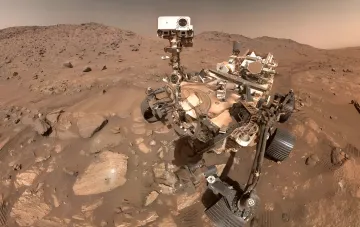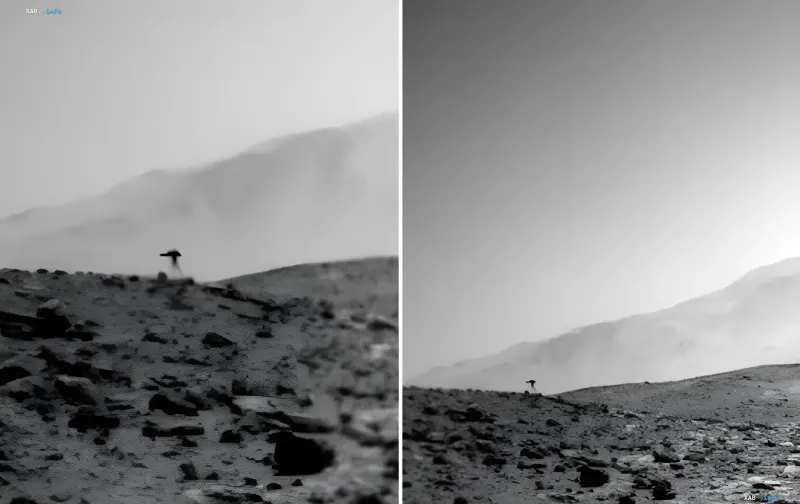
A new debate has erupted in the world of science and space enthusiasts, sparked by an archival image from a NASA Mars rover. On a black-and-white panorama taken by the Curiosity rover, a strange object is clearly visible, which social media users and amateur researchers have dubbed the "Martian jellyfish." The photograph, taken back in August 2023, has once again raised the eternal question: are we alone in the Universe?
"Jellyfish" at the Bottom of Gale Crater
The image was captured by the navigation camera of the Curiosity rover on the 3924th Martian day (sol) of its stay on the planet's surface. The date of the shot was August 20, 2023. The image captures the famous Gale Crater, which has a diameter of about 154 kilometers (96 miles). Against the backdrop of the misty slopes of Mount Sharp and the dusty sky on the horizon, a dark silhouette is clearly visible, resembling a creature with three "legs" and a sprawling "body".
The object caught the attention of enthusiast researcher Kari Sivertsen, who has been conducting a thorough analysis of NASA archives for several months, posting his findings on the social network X. It was his publication that became the catalyst for a new wave of discussions. Visually, the object does resemble an earthly jellyfish, but in a terrestrial version, which has spawned a mass of fantastic theories.
Hypotheses: From UFOs to Optical Illusions
Immediately after the publication of the image, various versions of the origin of the object began to circulate on the web. Some users suggested that it could be the Ingenuity helicopter, which has been operating on Mars since 2021. However, the shape of the object and its position on the terrain raise doubts among those familiar with the construction of NASA drones.
A more radical point of view was put forward by Mars researcher Jean Word. He suggested that the three-legged object could be a "potential UFO" — an unidentified flying object. "As always, until we get there personally and see these anomalies up close, I can only guess what it is," noted Word, emphasizing the impossibility of making a definitive conclusion from millions of kilometers away.
Contradictory Data
While some see proof of extraterrestrial life or technology in the image, skeptics urge to keep a cool head. In the history of Mars exploration, there have been many similar cases where shadows, rocks, and optical distortions of the camera were mistaken for signs of civilization. Remember the famous "Martian Spider," which turned out to be nothing more than wind blowing dust, or the "Head of the Sphinx," which became the result of a play of light and shadow.
Experts point out that the navigation cameras of rovers, unlike high-resolution scientific instruments, often produce grainy and distorted images. The object could be an ordinary rock of complex shape, a rock fragment, or even an artifact of the apparatus itself that ended up in the frame at a strange angle. The difference in interpretation between enthusiasts and professionals remains significant: the former seek sensations, the latter — rational explanations.
Curiosity Mission: Search for Signs of Life
Regardless of what exactly is depicted in the controversial image, the work of the Curiosity rover continues. The apparatus, which landed on Mars in 2012, has already significantly exceeded its initial service life. Its main task is the study of the geology and climate of the planet, as well as the search for signs of ancient microscopic life in the rocks of Gale Crater.
At the moment, Curiosity continues to explore the bottom of the crater, analyzing the composition of rocks and looking for organic compounds. If macroscopic life resembling "jellyfish" really existed on Mars, it would be the greatest discovery in human history, overturning our ideas about biology and space.
Conclusions for 2026
As of today, in August 2026, NASA has not officially confirmed the presence of life on Mars, and this image remains in the category of interesting but unexplained anomalies. For now, the "jellyfish" from Gale Crater is just a reason for new theories and discussions. However, with the development of technology and the emergence of new missions, such as new-generation rovers, humanity may soon get answers to questions that seemed unsolvable just a few years ago.