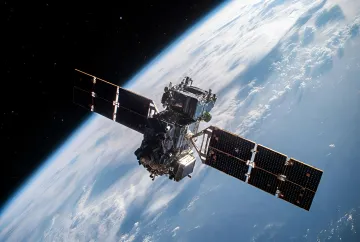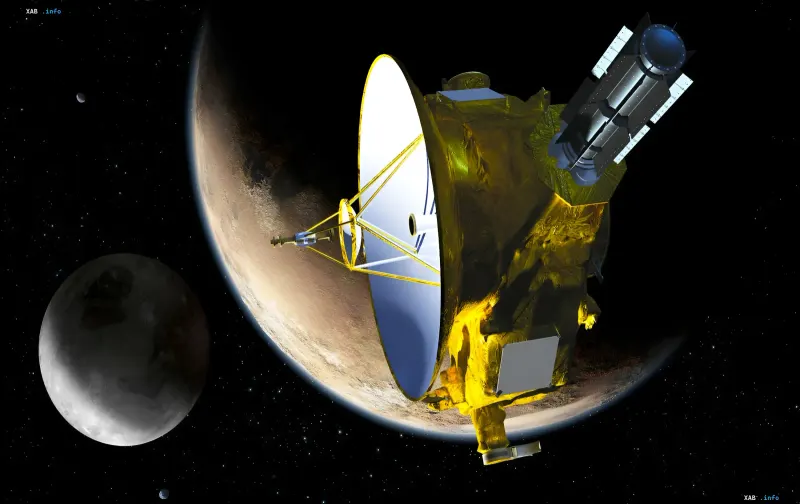
NASA's historic New Horizons interplanetary mission, which for more than two decades has been expanding the boundaries of human knowledge about the remote corners of the Solar System, is on the brink of a paradoxical crisis: the spacecraft may cross the boundary of the heliosphere and enter interstellar space with its key scientific instruments switched off. According to data obtained by the XAB.info editorial team, the mission team is forced to switch off two particle detectors as early as October 2026 — instruments without which a full study of the physics of the Solar System's boundaries is impossible. At the same time, the spacecraft itself is in excellent technical condition and has resources to operate at least until 2050.
A Financial Dead End: $2 Million That Changes Everything
The reason for the upcoming shutdown of the instruments lies in a bureaucratic and budgetary conflict within NASA itself. The agency's heliophysics division has blocked the annual funding of $2 million allocated for 2025 and 2026. It was precisely these funds that were directed to the operation of the particle detectors, which record the flows of solar wind and galactic cosmic rays. The mission's main operational funding of $10 million per year continues to be provided by NASA's planetary science division without interruption, which allows the spacecraft's life support and telemetry transmission to be maintained. However, without the additional $2 million tranche, the scientific workload directly related to studying the heliospheric boundary becomes impossible. The reasons why the heliophysics division decided to block the funds are not officially disclosed, which only intensifies the tension surrounding the situation.
What Exactly Humanity Risks Missing
The particle detectors on board New Horizons are of critical importance for studying the boundaries of the heliosphere — a giant protective 'bubble' formed by the solar wind and shielding the Solar System from galactic radiation. According to calculations, between 2029 and 2040 the probe will cross the so-called bow shock — the outer boundary of this bubble. Since New Horizons remains the only operating spacecraft in the outer heliosphere, switching off its instruments will deprive the scientific community of the only source of data on the physics of this fundamentally new region of space for humanity. Scientists emphasize: repeating such measurements in the coming decades will be impossible, as no other spacecraft approaches these distances.
NASA's Reaction and the Leadership's Position
NASA Administrator Jared Isaacman publicly stated that the agency is carefully examining the situation and is interested in obtaining scientific results from an already invested project. In his statement, he referred to appeals received from representatives of the scientific community and noted that New Horizons has demonstrated exceptionally high-quality scientific data throughout its operation at relatively modest costs. Nevertheless, the specific timelines and mechanism for restoring funding for the particle detectors were not announced at the time of publication.
Mission History: From Pluto to Interstellar Space
The New Horizons spacecraft was launched on January 19, 2006, and became the first mission directed to the Pluto system and the Kuiper Belt. In July 2015, the probe performed the first close flyby of a dwarf planet in human history, transmitting to Earth unique images that radically changed views of the icy world: giant ice mountains and extensive nitrogen glaciers were discovered. In January 2019, the spacecraft flew past the trans-Neptunian object Arrokoth (2014 MU69), making it the most distant object ever explored by a human-made spacecraft. At present, New Horizons is at a distance of about 9.7 billion kilometers from Earth and continues to move away at a speed that ensures its status as the most distant active object created by humanity.
Contradictory Data
The provided materials contain a number of inconsistencies that require careful consideration. On the one hand, it is stated that the spacecraft is in 'excellent technical condition' and has resources until 2050 — this indicates that the problem is not wear or equipment failure. On the other hand, it is precisely due to a budgetary decision within NASA that the key scientific instruments will be switched off, which effectively turns a working spacecraft into an 'empty shell' for the main goal of the mission — studying the interstellar boundary. In addition, the main $10 million for operational maintenance continues to be provided, which formally means that the mission is not 'suspended' in the full sense of the word, however its scientific value during the critical period of crossing the heliosphere will be lost. Finally, the reasons for blocking the $2 million tranche remain officially undisclosed, which makes it impossible to definitively assess whether this is a temporary delay or a systemic decision to redistribute priorities within NASA.