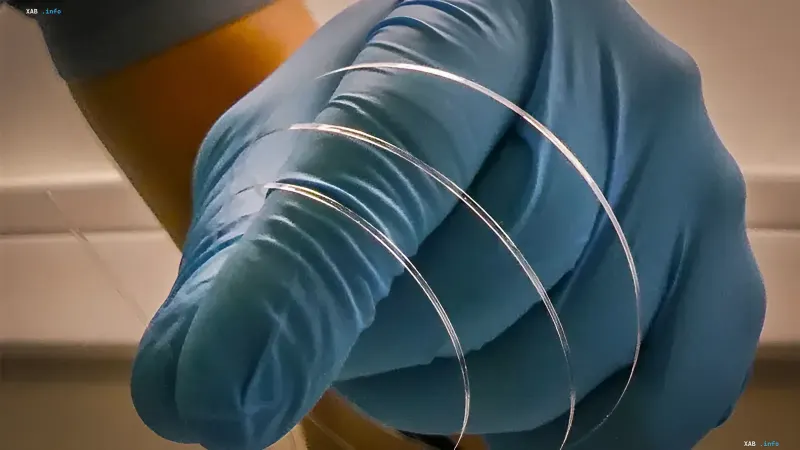
A true revolution has occurred in the world of sensor technology, one that could fundamentally change the approach to monitoring the condition of critical infrastructure, aviation, and even medical systems. Researchers from the Royal Institute of Technology in Sweden (KTH), as well as the Universities of Southampton and Bristol in the UK, have presented an innovative platform called HARFF (High Aspect-Ratio Flat Fiber). This flat optical fiber not only transmits data but also acts as a hypersensitive sensor capable of "feeling" pressure and temperature with accuracy exceeding traditional technologies by a thousandfold.
From Round to Flat: Geometry as the Key to Sensitivity
Traditional optical fiber, used for decades to transmit the internet and telephone signals, has a circular cross-section. However, researchers have discovered that changing the geometry of the fiber can radically enhance its physical properties. The new HARFF fiber has an elongated quadrangular, almost ribbon-like cross-section. In experiments, a width-to-thickness ratio of approximately 20:1 was achieved. This shape drastically alters the mechanical response of quartz glass to transverse load. As a result, the experimental pressure sensor created was found to be up to three orders of magnitude (i.e., 1,000 times) more sensitive than similar devices based on traditional round fiber.
Working Principle: Micro-cavities and "Smart" Alloys
The magic of HARFF lies not only in its shape but also in its internal structure. To give the fiber the ability to determine temperature and pressure, micro-cavities are created within it, and additives in the form of metals and alloys are introduced. For example, to create a highly sensitive thermometer, one of the channels is filled with a tin-based alloy with a melting point of about 220 °C. When heated, the metal expands, creating mechanical stress in the glass that changes the refractive index of light. This change is easily detected by standard telecommunications equipment. For pressure measurement, microstructured fibers with air channels are used, with a resolution reaching units of kilopascals.
Compatibility with Existing Infrastructure
One of the main advantages of HARFF technology is its compatibility with existing equipment. The flat fiber can be spliced with standard round optical fiber and connected to standard optical equipment. This means that using the new properties does not require purchasing expensive new "hardware" or completely replacing communication networks. The technology is ready for integration into current monitoring systems, which significantly accelerates its commercialization and industrial application.
Applications: From Aircraft to Batteries
Developers see wide applications for "glass nerves" in various fields. Flat fibers can be embedded directly into composites of aircraft, drones, bridges, and other structures, turning them into self-diagnosing systems. Of particular interest is the possibility of embedding sensors inside batteries to record electrode expansion, gas generation, and dangerous temperature rises, which is critical for preventing fires in electric vehicles and power systems. Additionally, the technology is finding applications in medical monitoring systems where high precision and biocompatibility are required.