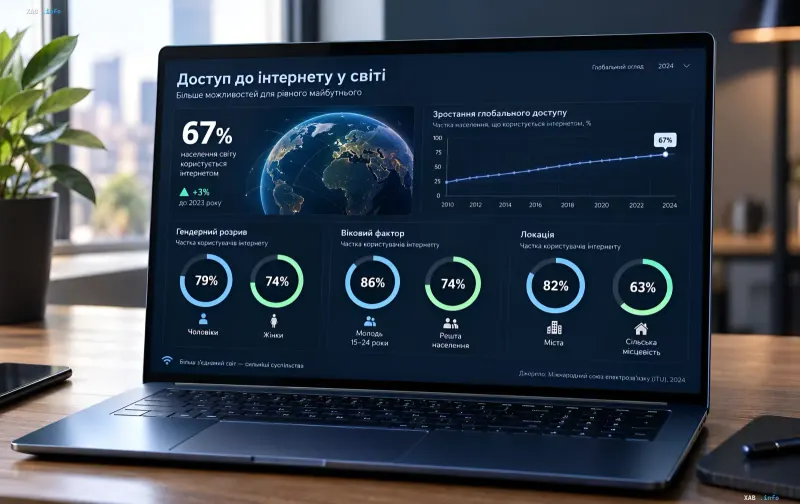
Despite the rapid spread of digital services and artificial intelligence, a significant portion of humanity remains outside the global network. The latest report from the International Telecommunication Union (ITU), "Facts and Figures 2026," cited by RBC-Ukraine, notes that 6.3 billion people use the internet in 2026, representing 76% of the global population. However, about two billion people, or 24% of the world's population, still lack access to the network. Compared to last year's data, this figure has decreased slightly: a year earlier, 2.2 billion people were without connection, yet the pace of closing the gap remains slow.
The Global Picture: 76% Online and Two Billion Offline
Analysts emphasize that while connectivity trends are positive, they are insufficient to claim full coverage. While in 2025 the number of unconnected people was about 2.2 billion, it dropped to approximately two billion in 2026. This means only about 200 million users joined the network over the year, while the vast majority of those offline are concentrated in the world's poorest regions, where infrastructure, device costs, and digital literacy levels form a complex barrier.
Gender and Age Gaps: Who Remains Offline
The report reveals persistent disparities in who has internet access. By gender, the gap is five percentage points: 79% of men use the network compared to 74% of women. The age gap is even more pronounced — young people aged 15 to 24 are connected to the global "web" at 86%, while this figure is 74% for the rest of the population. Thus, women and older age groups consistently lag behind the average connectivity level, which limits their access to education, labor markets, and digital government services.
Urban vs. Rural: The Geography of Inequality
The deepest divide is recorded by place of residence. In cities, 82% of residents have internet access, whereas in rural areas this figure drops to 63%. The 19-percentage-point gap means that almost every third rural resident remains offline, whereas only every fifth person in cities is unconnected. Geography, according to experts, is one of the key drivers of global digital inequality.
Mobile Devices and Economic Inequality
Beyond network access, ITU analysts examined mobile device ownership among people over 10 years old. Globally, 84% of the population owns a phone; however, there is a massive gap between economic categories of countries: in high-income states, this figure reaches 95%, while in low-income countries it is only 57%. This confirms that network access is determined not only by the availability of towers and cables but also by the ability of households to acquire devices.
Infrastructure Is Not Enough: A Push for Digital Skills
ITU experts emphasize that expanding technical infrastructure alone is not enough to bridge the current gap. According to union representatives, the priority must be the development of digital skills among the population, as without them, the benefits of modern technologies and artificial intelligence will remain inaccessible to a significant portion of the global community. In other words, even with a network and a device, a person without basic digital literacy cannot fully utilize the opportunities of the "digital age," making education the central condition for reducing inequality.