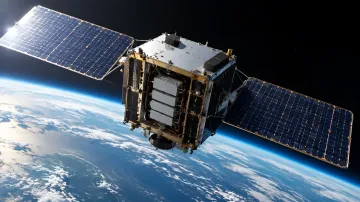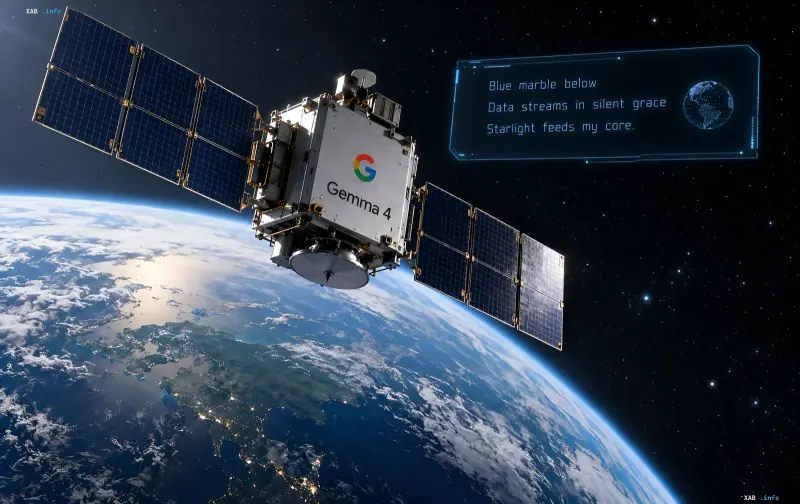
On October 1, 2026, Google launched a satellite prototype into Earth's orbit as part of the Suncatcher research project. This event marks the first historical confirmation that a modern neural network model is capable of performing full-scale computational tasks directly in space—without transmitting requests back to Earth. The spacecraft carries the open-source Gemma 4 AI model running on Google TPU processors, and it was this model that generated a response to a text prompt transmitted by engineers from a ground station.
First Communication Session: A Haiku from Beyond Orbit
Following deployment, specialists spent several weeks conducting comprehensive system checks on all onboard spacecraft systems. During a routine communication session with the ground station, engineers sent the first text prompt to the Gemma 4 model. At first glance, the task seemed trivial: the system was asked to write a short haiku about being in space. As the spacecraft flew over the Norwegian archipelago of Svalbard, the station received the generated poem back: 'Blue marble below / Data streams in silent grace / Starlight feeds my core'. Successful reception of the response confirmed that the full cycle—from receiving the prompt, processing it on the onboard chip, to transmitting the result back to Earth—functions properly in the orbital environment.
Four TPUs and One Kilowatt: Strict Power Constraints
The computing unit architecture of the Suncatcher satellite includes four Google TPU processors. However, due to the limited capacity of the onboard power system, only a single chip can operate at any given time, while the others are activated in rotation. The spacecraft generates approximately one kilowatt of electricity, forcing engineers to strictly limit the duration of computing sessions. These constraints dictate what tasks the model can perform autonomously: for now, the focus is on short generative prompts and telemetry processing rather than the heavy inference workloads typical of large language models on Earth.
Limericks and Telemetry: Expanding the Test Program
Immediately after successfully receiving the haiku, the Suncatcher team transitioned to an expanded test program. Engineers tested other generative creative formats, specifically requesting space-themed limericks from the model. In parallel, requests were executed to retrieve telemetry data concerning the technical health of onboard systems and payloads. This verified that the Gemma 4 model in orbit is capable not only of 'creative' operations but also of structured engineering data processing, which is critical for future autonomous monitoring and diagnostics of satellite constellations.
2027: Transitioning to a Connected Two-Satellite Network
Successful chip testing in orbit paves the way for the next phase of the mission. In 2027, Google plans to launch two interconnected satellites that will operate within a unified computing network. Moving from a single spacecraft to a networked configuration will allow load balancing across multiple nodes, increased total computing power, and the implementation of more complex scenarios—from inter-satellite data transfer to coordinated problem solving. According to the developers, this is the first step toward creating large-scale computing systems located off-Earth, known as orbital data centers.
Why AI Needs Space: The Logic of the Suncatcher Project
The Suncatcher project is positioned by Google as a long-term research experiment. Its goal is to study how to supply AI models with computing power and electricity directly in space, bypassing the latency and bandwidth limitations of terrestrial communication links. If the experiment confirms economic and technical feasibility, it could reshape orbital infrastructure architecture: instead of transmitting raw data back to Earth for processing, a portion of intelligent tasks will be handled onboard, reducing response times and easing the load on terrestrial data centers. At this stage, the company is limiting itself to a prototype and a series of additional tests scheduled by engineers over the coming weeks.