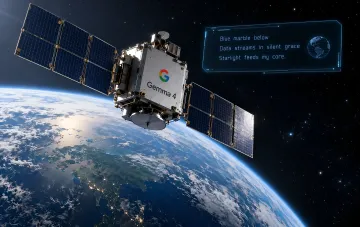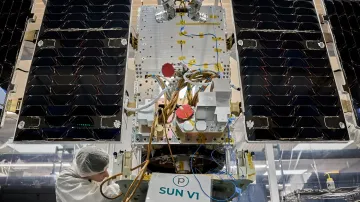
Google has announced the successful in-orbit test of its custom Tensor Processing Units (TPUs) directly in Earth's orbit. According to the company, engineers activated onboard chips during the test, allowing the Gemma 4 artificial intelligence model running on them to receive a prompt in space and generate a response for the first time in history. This milestone marks a practical step forward within Project Suncatcher, Google's experimental initiative to build AI computing infrastructure outside of Earth rather than solely in terrestrial data centers.
First Prompt in Space: A Haiku About Orbiting
According to Google, the Gemma 4 model was tasked with writing a haiku — a short three-line poem — about being in space. In response, the system outputted three lines: «Blue marble below / Data streams in silent grace / Starlight feeds my core». The company highlights the successful response generation aboard the satellite as the first confirmation that an AI model can execute prompts in orbital conditions rather than just in terrestrial laboratory environments.
Beyond Poetry: Limericks and Telemetry
In addition to the haiku, Google tested the model with other space-themed prompts. These tests included composing limericks — humorous five-line poems — as well as processing telemetry data generated by the satellite during flight. By doing so, the company evaluated not only the model's 'creative' capabilities but also its ability to handle technical data streams, which is critical for real-world orbital computing tasks.
What is Project Suncatcher
The test is part of Project Suncatcher, an experimental Google program aimed at establishing AI computing infrastructure directly in orbit. The satellite equipped with the TPUs was launched into space earlier in October, according to the company. This initiative is viewed as a step toward assessing the feasibility of orbital data centers: moving computations to orbit allows researchers to study how well such systems can handle AI workloads over the long term.
Thermal Loads and Radiation: The Main Challenge
Google stated that the primary objective for the upcoming phases is to verify chip reliability in environments unfamiliar to terrestrial electronics. The company noted that future tests will focus heavily on thermal stresses and cosmic radiation exposure — factors that directly impact chip stability and calculation accuracy in orbit. The results of these tests will determine whether onboard TPUs are suitable for continuous operation off-Earth.
Outlook: Two Interconnected Satellites in 2027
If current tests prove successful, the next phase of Project Suncatcher will involve launching two interconnected satellites, scheduled by Google for 2027. The company intends to use the data gathered from the first satellite to evaluate the prospects of establishing orbital AI data centers, potentially laying the foundation for a new computing architecture distributed between Earth and orbit.