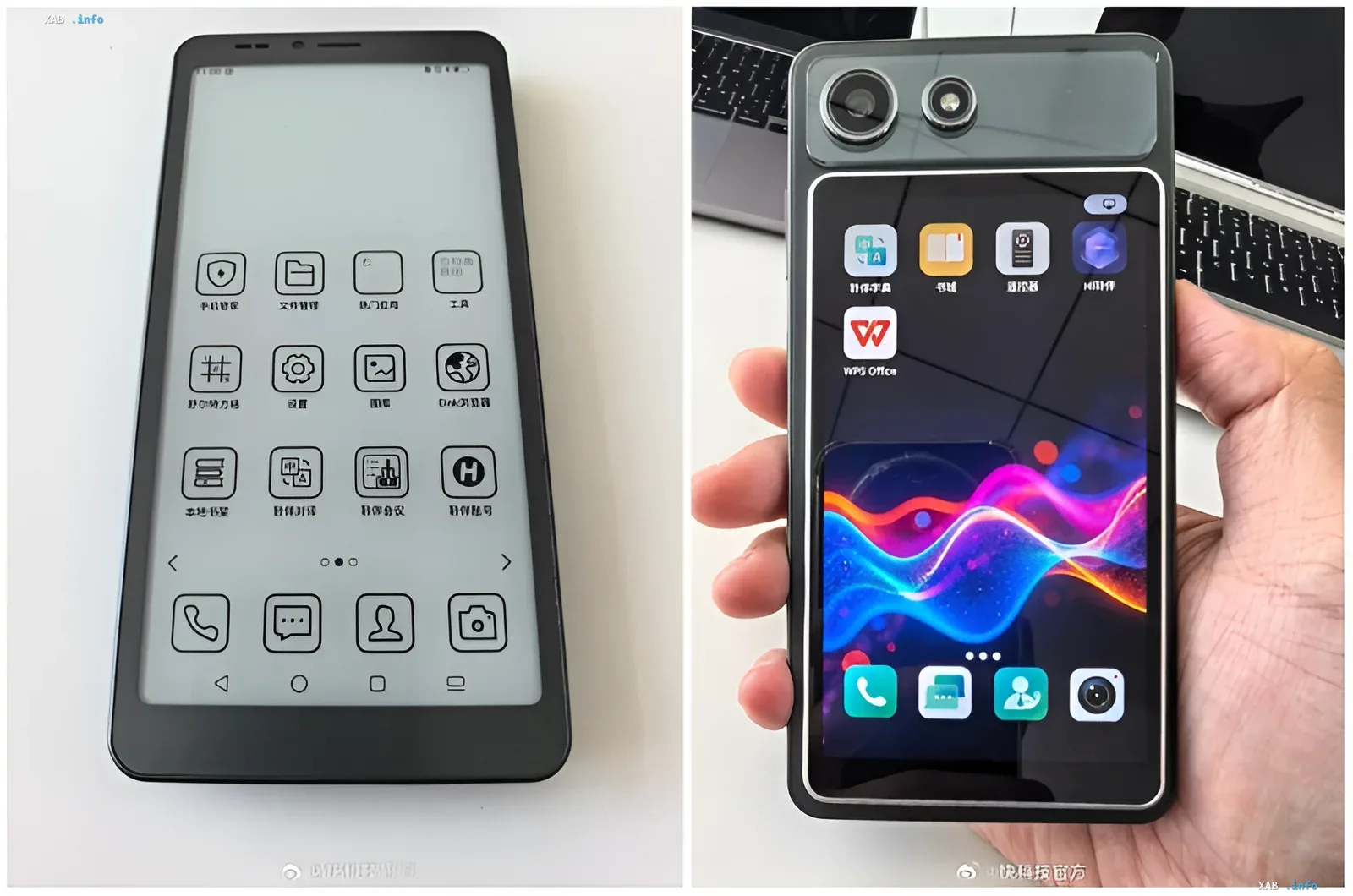
Against the backdrop of growing interest in eco-friendly and energy-efficient technologies, Chinese vendor Hisense continues to experiment with unconventional form factors. While in June and July 2026 we were only discussing the concept of the device, now, in August, we have real photos of the Hisense A10 smartphone. The device represents a unique hybrid: the main screen is made using electronic ink (E Ink) technology, while a separate, detachable color display is provided for multimedia consumption.
Dual Nature: E Ink and Detachable Module
The main feature of the Hisense A10 is its main screen, made using E Ink technology. This solution, familiar from e-readers, is integrated here into a full-fledged smartphone. This approach allows for a significant reduction in eye strain during reading and extends battery life. However, considering the limitations of black-and-white matrices, Hisense engineers found an unconventional solution: an additional color LCD display attaches magnetically to the device body.
According to data confirmed by the company's official representative Lao Zuo, the detachable module has a diagonal of 6.13 inches. Real photos demonstrate that this screen possesses high brightness and saturated color reproduction, making it a full-fledged replacement for traditional OLED panels in modern smartphones. It is important to note that this module is not included in the standard package and will be sold separately, which could significantly affect the total cost of ownership.
Hardware and Performance
Under the hood, the Hisense A10 hides the Qualcomm QCM6690 microprocessor, also known as Dragonwing Q-6690. This chipset is already familiar to enthusiasts from the Boox Note X6 e-reader. In terms of performance, it is comparable to the Unisoc T9100, positioning the device in the entry-level and mid-range segment. This is a logical solution for a niche product where priority is given not to gaming graphics, but to interface stability and energy efficiency.
To ensure the correct operation of the main E Ink screen, a separate T2000 TCON chip is used. This controller is responsible for the matrix refresh rate and other display parameters, which is critical for minimizing flicker and ensuring smooth animations in the interface. The presence of a specialized chip for managing the E Ink panel speaks to the developers' serious approach to the quality of visual perception.
Control and User Experience
The transition between operating modes — from black-and-white E Ink to the detachable color module — is implemented flexibly. The user can choose one of three switching methods: use the physical Ink Smart Key button, activate the function through settings, or use the quick menu. Such a multi-level control system allows the device to be adapted for different usage scenarios: from working with documents to watching videos.
Judging by the photos, the smartphone interface is optimized for working with both types of displays. The E Ink screen displays a minimalist interface with icons reminiscent of retro devices, while the color module runs a full version of the operating system with bright widgets and applications. This confirms that the Hisense A10 is not just an experiment, but a ready-to-use device with a well-thought-out UX.
Contradictory Data
Despite the abundance of information, some aspects remain unclear. In particular, the exact specifications of the detachable LCD display (resolution, matrix type, refresh rate) have not yet been revealed. There is also no official data on battery capacity and fast charging support. Some sources suggest that the detachable module may have its own battery, but this has not yet been confirmed.
Furthermore, there is disagreement in the performance assessments of the Qualcomm QCM6690 chip. While some experts compare it to the Unisoc T9100, others point to potential limitations in working with heavy applications and games. This could be a problem for users expecting a universal device.
Presentation Date and Cost
The official presentation of the Hisense A10 will take place in China on August 28, 2026. Given the use of an entry-level chip and the niche nature of the product, one can expect the smartphone to be offered at an affordable price. However, considering the need to purchase the detachable display separately, the total cost of the kit may turn out to be higher than expected.
The Hisense A10 is a bold step towards personalization and eco-friendliness in the world of smartphones. If the device gains widespread adoption, it could become a catalyst for the emergence of new hybrid solutions in the mobile device market.