Freezing seasonal fruit is not difficult, but after the freezer it behaves very differently from fresh fruit. This is especially noticeable with plums and grapes: after fully thawing, they become noticeably softer, because ice crystals damage the fruit's cellular structure. So the main question is not simply “how to freeze,” but how to prepare the fruit for the specific task you will use it for in winter. Below are several non-obvious techniques that help you better preserve the seasonal harvest and avoid ending up with a single block of ice or a darkened mass.
Why Freezing Changes Texture: The Physics of Ice Crystals
Freezing does not fully preserve the original texture of the fruit. As ice crystals form, the cellular structure is damaged, and after thawing the fruit becomes softer. This is exactly why grapes are best used slightly frosted or for drinks, juices, and jellies, while plums are best for baking, compotes, sauces, and other dishes where a softer texture is not a problem. Understanding this mechanism is the key to not being disappointed with the result.
Grapes: Tray Freezing vs. a Block of Ice
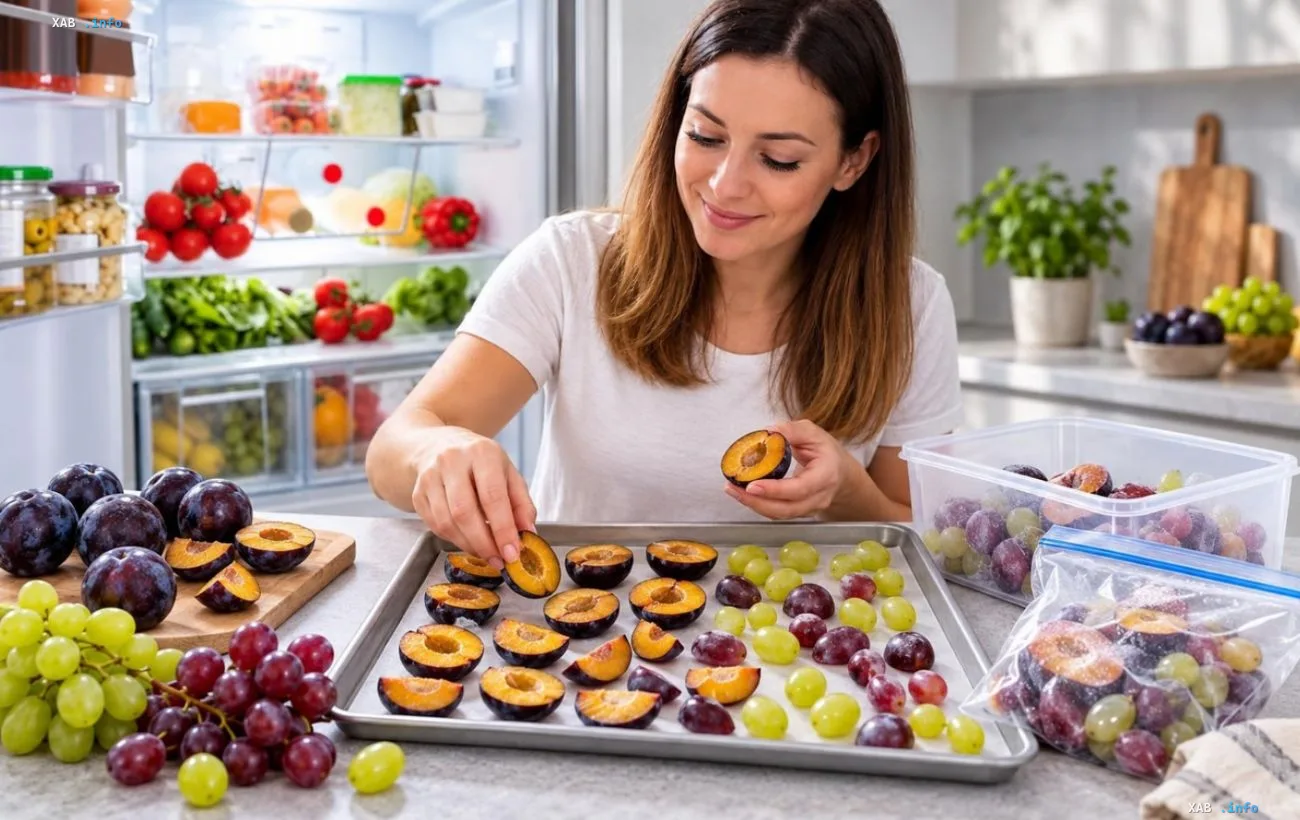
This is one of the simplest ways to get individual berries in winter instead of one big block of ice. Instead of immediately pouring the grapes into a bag, spread the berries in a single layer on a tray or baking sheet and place them in the freezer. Once they are fully frozen, transfer them to a bag or container. Utah State University Extension recommends freezing grapes this way for later use as individual berries, and Penn State Extension also notes that whole berries can be frozen using so-called tray freezing. Bonus: such berries can be taken out one by one and used as a kind of “ice cubes” for drinks.
Grapes: Use Slightly Frosted, Not Fully Thawed
Here is a nuance that is often overlooked. Extension experts explicitly warn: fully thawed grapes become soft. Therefore, frozen berries can be used while still slightly frosted — for example, as a cold fruit snack or added to drinks. If the grapes are intended for juice or jelly, they can be frozen without adding sugar. In other words, the freezer here works not as a way to get “fresh grapes” in winter, but as a way to preserve them for specific purposes.
Plums: Cutting for the Dish and Syrup Packing
Plums may be frozen whole, in halves, or in quarters — the main thing is that the pit is removed. But there is a practical tip: before freezing, cut the fruit exactly as it will be used in the future dish. For example, halves are convenient for pies and casseroles, while small pieces work well for compotes, sauces, or fillings. The National Center for Home Food Preservation allows freezing plums without added sugar and also recommends syrup packing for them — 40–50% cold syrup depending on the fruit's acidity.
Ascorbic Acid Against Darkening
After freezing and thawing, some fruits may darken. For plums, home preservation specialists recommend ascorbic acid (vitamin C) as a means that helps slow down color change. For example, NCHFP recommends adding it to the syrup for freezing plums; for the dry method there are also recipes with ascorbic acid. This does not mean that plums will definitely darken without vitamin C: it is just one of the ways to better preserve their appearance.
Sugar Is Not Required, and Overripe Plums — Into Purée
Another non-obvious point: adding sugar when freezing fruit is not mandatory. It is used primarily for quality — sugar or syrup packing can help preserve texture and flavor. At the same time, plums and grapes can be frozen without sweetening. For plums that will go into a pie or compote in winter, the unsweetened option is often more practical: you do not tie the fruit to a specific dessert. If some plums are very ripe and soft, there is no need to try to keep them in whole pieces: from such fruit you can make plum purée or sauce, cool it, portion it into containers, and freeze it. NCHFP separately describes a method for freezing plum sauce — well-ripe fruit is cooked until soft, the pits and skin are removed, and then the pulp is simmered with juice to the desired thickness. This is especially convenient if in winter you plan to add plum to syrniki, pancakes, porridge, or desserts.