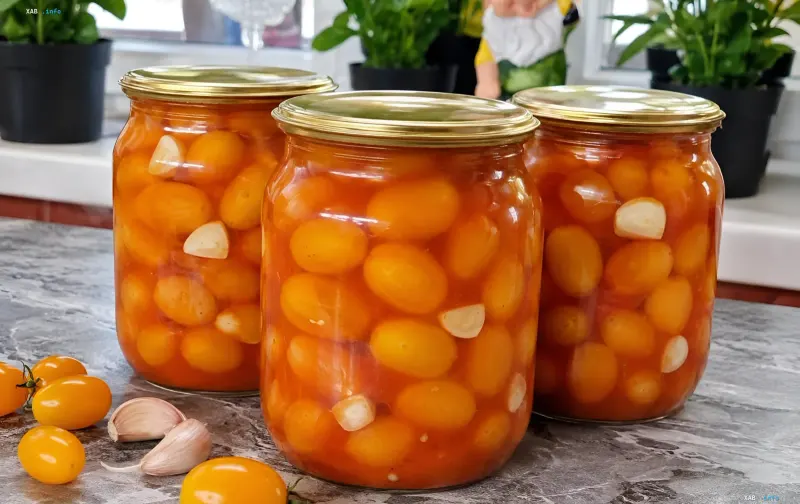
The home preserving season in August 2026 is in full swing, and small cherry tomatoes are becoming one of the most in-demand ingredients for canning. Compared to larger fruits, they are easier to pack, heat up faster, and after pickling yield a bright, piquant snack that in winter pairs perfectly with meat dishes, side dishes, and a festive table. Food blogger Ptashka Nadia, whose recipe is featured by Styler (an RBC-Ukraine project), offers a pickling version with chili ketchup and garlic: the combination of sweet and spicy makes the marinade rich, and the process requires no advanced skills. Importantly, the recipe is versatile — both red and yellow cherry tomatoes work, and if desired, regular small, firm tomatoes can be used as well.
Choosing and Preparing the Fruit: Firmness Is Key
The crucial stage that determines the outcome is selecting the tomatoes. For preserving, you need ripe but sufficiently firm fruits without cracks, damage, or signs of overripeness: it is these that keep their shape after pickling and do not fall apart into "mush." Specialists at Penn State Extension explain the cracking mechanism: when the interior of the fruit expands faster than the skin, the skin cannot withstand it and splits; in overripe tomatoes the skin is weaker, so the risk of damage increases. The National Center for Home Food Preservation reinforces this recommendation: only quality fruits are acceptable for home canning, damaged specimens should be rejected immediately, and cherry tomatoes must be packed into the jar carefully, without pressing hard, so as not to damage the skin. The jar (one-liter) and lid are washed and sterilized in advance by a convenient method, the tomatoes are sorted, washed, and packed tightly but gently, with a large garlic clove cut into pieces added.
Step-by-Step Pickling Recipe with Boiling Water and Chili Ketchup
The preserving technique is based on the classic method of pouring boiling water. After packing the cherry tomatoes and garlic, the jar is filled with rolling boiling water, covered with a lid, and left for about 10 minutes — this is enough for small cherry tomatoes. Then the water is carefully drained into a pot (a one-liter jar yields approximately 400 ml of liquid) and brought to a boil on the stove. While the marinade heats up, salt, sugar, vinegar, and chili ketchup are added directly into the jar, after which the tomatoes are filled with boiling water to the very top. The jar is closed with a lid, turned upside down, wrapped tightly in a towel or blanket, and left to cool completely. Adhering to proven proportions of acid, salt, and sugar, as well as the sterility of the containers, is a mandatory condition for long-term storage of the preserve.
Adjusting Flavor and Spiciness
The main feature of this preserve is the balance of sweet and spicy: chili ketchup gives the marinade depth and a pleasant piquancy, while garlic enhances the aroma. At the same time, the spiciness is easy to control — if fiery snacks are not to your taste, the chili ketchup can be replaced with regular mild ketchup, and the tomatoes will remain aromatic and piquant, but without pronounced heat. Experts also remind that the fruits in the jar should not be packed too tightly, and for even heating it is better to choose cherry tomatoes of roughly the same size.
Contradictory Data
In popular home practice, there is a widespread tip to prick the tomatoes with a toothpick near the stem to "relieve the tension" and keep the skin intact. However, authoritative recommendations on home canning do not include this method, and it cannot be regarded as a guaranteed way to protect against cracking. Thus, there is a discrepancy between folk experience and the position of specialized food preservation centers: experts rely on selecting firm, unoverripe fruits and gentle packing, rather than on mechanical pricking. Until the issue is settled by a unified practice, it is safer to follow the specialists' recommendations and not rely on pricking as the main method.
Storage Safety and Conclusion
For long-term storage, it is critical not to change the vinegar proportions "on a whim": home canning requires adhering to proven ratios of acid, salt, and sugar and using prepared jars and lids. Following these rules, together with the proper choice of cherry tomatoes, allows you to obtain a winter snack that will retain its shape, color, and piquant taste. The recipe, in addition to cherry tomatoes, is also suitable for small firm regular tomatoes, which makes it a flexible tool for seasonal preserving. Previously, Styler published a recipe for Bessarabian pickled tomatoes for winter, so the lineup of proven options for home canning continues to expand.