In autumn, pumpkins become especially abundant, and not every fruit needs to be turned into puree, made into pancakes, or frozen right away. Ripe fruits with a hard skin can be stored for several months if they are properly prepared and placed in a suitable location. The key rule: only healthy, fully ripe fruits without dents, cracks, or punctures are suitable for long-term storage. According to Penn State Extension, damage to the skin shortens the storage period and becomes an entry point for bacteria and the development of rot.
Preparing the pumpkin for storage: what to do right after harvest
After harvesting, it is advisable to leave the pumpkin to cure and dry for about 7–14 days in a dry, well-ventilated place. During this time, the skin becomes harder and better protects the flesh. If the weather allows, the fruits can be left in the garden, but they must be protected from rain. It is also important not to carry the pumpkin by the stem — it may break off, and the damaged spot increases the risk of the entire fruit spoiling.
Optimal conditions: temperature and humidity
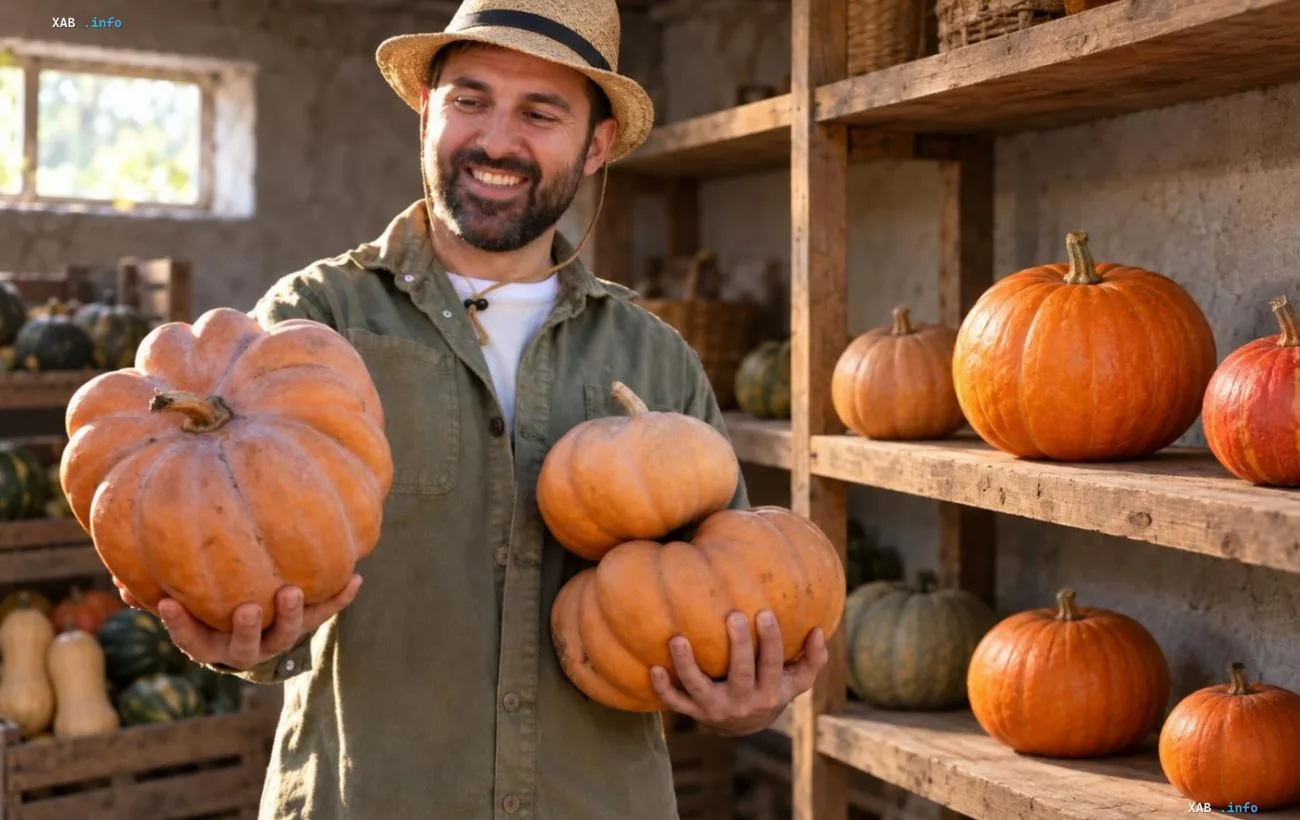
The best place for a pumpkin is a dry, cool, and well-ventilated room: a dry basement, a pantry, a garage, or any other space where there is no risk of freezing. It is better to lay the fruits in a single layer, not touching each other, so that air can circulate freely. The pumpkins should be checked periodically: if a soft or suspicious spot appears on one fruit, it should be separated from the others immediately so that the rot does not spread to the neighbors.
Contradictory data
Recommendations on the microclimate vary in their figures across different agricultural sources. Penn State Extension states that for long-term pumpkin storage, approximately 10–16 °C and a relative humidity of 50–75 % are optimal, while a temperature below about 10 °C is undesirable because it may cause chilling injury. At the same time, the University of Minnesota recommends storing pumpkins in a narrower range — 10–13 °C and humidity of about 50 %. Thus, the upper temperature limit and the acceptable humidity differ between sources: from 13 to 16 °C and from 50 to 75 %, respectively. In practice, this means that a safe guideline is the lower part of the range — about 10–13 °C with moderate humidity, while warmer and more humid conditions are acceptable but increase the risk of spoilage.
Where to store a pumpkin in an apartment and at a dacha
If there is no special cellar, pumpkins can be stored under ordinary home conditions. Gardeners advise placing the fruits on dry straw, hay, sawdust, or wood shavings so that they do not rest directly on a cold or damp surface. A simple and effective trick is to lay the pumpkins stem-up, leaving a little space between them: this way the fruits will not touch each other, and air will circulate better. If space is very limited, whole and undamaged pumpkins can be stored even under a bed or on top of a wardrobe — provided it is dry there, there is no radiator nearby, and there are no sharp temperature fluctuations.
How long can a pumpkin be stored: storage periods and varieties
Storage periods largely depend on the variety. For most pumpkins, Penn State Extension indicates approximately 2–3 months under proper conditions. Some winter varieties, such as Hubbard, can last significantly longer — up to 5–6 months. Therefore, the promise of "until spring" does not apply to every pumpkin. The most important factors for long-term storage are a ripe, undamaged fruit, proper curing, coolness, and good ventilation. Observing these four conditions allows you to extend the pumpkin's consumption period by several months without loss of quality.