Sticky grease buildup on a kitchen hood is one of the most common issues in a home kitchen. Many appliance owners, trying to quickly deal with the contamination, grab a metal sponge or harsh chemical, unaware that they are causing irreparable damage to the surface and control elements. Home appliance manufacturers — Samsung, Bosch, Elica — are unanimous on one thing: a soft cloth and liquid detergent are sufficient to clean the body, while removable filters require a separate, more delicate approach. The XAB.info editorial team has gathered key recommendations to help restore the hood to its original appearance without the risk of breakdown.
Safety First: Preparation for Cleaning
Before you start cleaning, you must turn off the stove and the hood itself, then wait for the body and filters to cool down completely. A critically important step is to disconnect the appliance from the power grid. Removable parts should be removed strictly according to the specific model's instructions, supporting them from below to avoid damaging the mounts. Throughout the cleaning process, water must not enter the electrical components — this is a direct path to a short circuit and equipment failure. That is why manufacturers strongly advise against using steam cleaners: the steam jet easily penetrates hard-to-reach areas and reaches the electronics.
Body Cleaning: What You Can and Cannot Do
For exterior surfaces, Samsung recommends using a soft cloth, such as microfiber, and a small amount of liquid detergent. The algorithm is simple: apply the solution to the cloth, gently wipe the contaminated area, and then wipe the surface dry with a clean napkin. If the body is made of stainless steel, it should be wiped along the metal texture to prevent microscopic scratches. Repeat the procedure if necessary. Metal sponges, abrasive pastes, chlorine-containing and alcohol-based cleaners are strictly prohibited: they destroy the protective coating, dull the metal, and can damage the control panel. An alternative homemade option, confirmed by other sources, is a 1:1 vinegar and water solution, which effectively dissolves the grease film without aggressive effects.
Metal Filters: Step-by-Step Instructions According to Bosch Standards
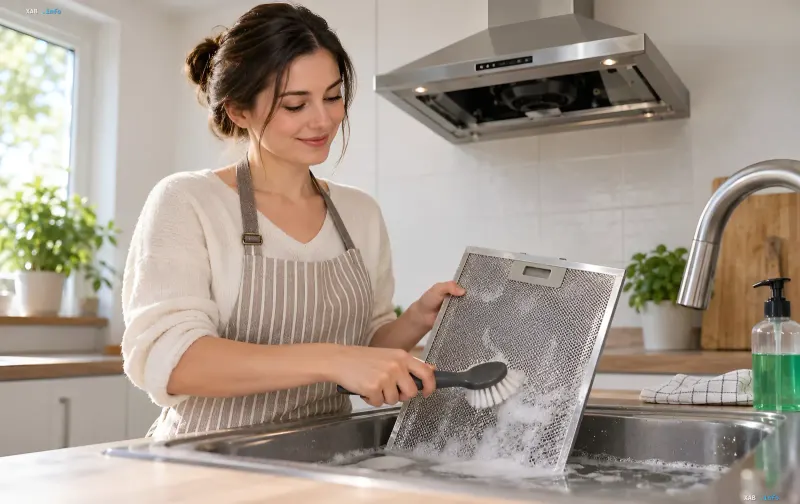
Reusable metal grease filters approved by the manufacturer for washing require special care. If the manual for your model does not specify otherwise, you can follow the sequence recommended by Bosch. First, the filter is carefully removed from its mounts, supporting it from below. Then it is soaked for about 10 minutes in hot water with dish soap added. The softened grease is removed with a soft nylon brush, taking care not to deform the mesh. After that, the filter is thoroughly rinsed with clean water and dried completely before reinstalling. If a specific stain requires a special degreaser, always check if it is approved for your filter's material: the "for kitchen" label on the packaging does not mean compatibility with every metal part. Disposable fibrous grease inserts cannot be washed — they should simply be replaced.
Maintenance Frequency and Dishwasher Washing
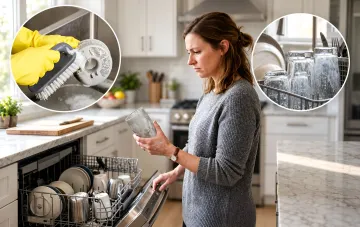
Elica advises cleaning metal grease filters about once a month under normal cooking conditions. If you cook daily over high heat, the cleaning interval should be shortened. Dishwasher washing is permissible only if explicitly allowed by the filter manual. For instance, Elica recommends an exclusive low-temperature cycle for aluminum filters. There is no universal temperature for all models, so guessing a hot program is not recommended. It is important not to let the mesh become covered with a thick layer of hardened grease: it impairs airflow, reduces hood efficiency, and increases the risk of fire. A deformed or damaged filter must be replaced without attempting repair.
Carbon Filters: Special Rules and Lifespan
Carbon filters are used in recirculation mode, when the hood does not vent air outside but returns it to the kitchen after purification. They trap odors, but their maintenance is fundamentally different from that of metal meshes. The key rule: do not soak or heat a carbon filter until you determine its exact type. Renewable carbon filters also have a limited lifespan — the manufacturer specifies 2–3 years for the OdourClean Plus model, and up to 5 years for OdourClean Pro with proper maintenance. After this period, the filter loses its sorption capacity and needs replacement, no matter how clean it looks externally.