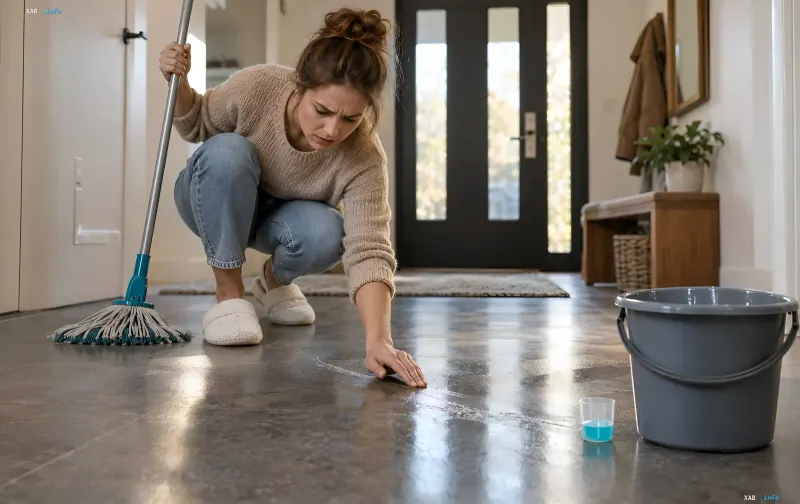
The floor has just been washed, but bare feet feel a slight stickiness, and streaks appear in the light. Dust is visible again on furniture and shelves, even though you are sure you wiped everything. According to manufacturers of home appliances and cleaning products, in most cases the reason is not the flooring quality or an "off" day, but systemic errors in cleaning techniques: an excess of detergent, dirty water, the wrong sequence of actions, and improper tool care. These mistakes not only prevent you from achieving the desired cleanliness, but also accelerate the accumulation of new dirt, creating the sensation that the floor "gets dirty" faster than usual.
Excess Detergent: Why "Just a Little Bit More" Ruins the Result
The most common mistake is pouring cleaner "by eye." Recommendations for wood floors provided by the O-Cedar brand state outright: an excessive amount of cleaning agent leaves a sticky residue on the surface to which dust, pet hair, and shoe prints instantly adhere. A similar mechanism is described by Rhonda Wilson, Head of Quality at FreshSpace Cleaning: leftover detergent acts as a magnet for dirt, and the next day the surface looks as if no cleaning was done at all. The correct approach is to strictly follow the dosage on the package: dilute the concentrate in the specified proportions and use the ready-to-use product in the volume recommended by the manufacturer. If stickiness has already appeared, experts advise wiping a small area with a well-wrung, clean cloth dampened with water and waiting for it to dry completely: if the surface becomes pleasant to the touch, detergent residue was indeed the cause, and the rest of the floor can be re-washed in a similar way.
Sequence of Actions: Top to Bottom and from the Far Corner
The second group of mistakes relates to the cleaning sequence. According to an explanation by Which?, when cleaning furniture, dust and small debris inevitably settle downward. Therefore, you must move strictly from top to bottom: first upper shelves, cornices, and cabinets, then middle and lower surfaces, and only at the end — vacuum or sweep the floor and, if the flooring permits wet cleaning, wash it. Inside a room, the logic of movement is different: you should start from the far corner and move toward the exit so as not to step on already cleaned areas and leave footprints. In addition, before wet cleaning, experts strongly recommend performing dry cleaning: crumbs, pet hair, and large debris do not dissolve in water, but are merely smeared across the surface.
Dirty Water and a Soiled Mop Head: Invisible Enemies of Cleanliness
The third typical mistake is rinsing the mop in the same water throughout the entire cleaning session. As Vileda recommends, the water must be changed as it gets dirty, sometimes several times per session. Otherwise, some of the already collected dirt returns to the floor, and you effectively transport it from one corner to another. Cleaning expert Rosa Picosa emphasizes that this exact scenario — dirty water plus excess detergent — most often leads to the floor looking worse after washing than before. Checking the condition of the mop head is equally important: if it is soiled itself, it must be rinsed or replaced with a clean one. After finishing the cleaning, the mop head is cleaned in accordance with the manufacturer's instructions to avoid carrying over old solution residues during the next use.
Microfiber and Fabric Softener: A Hidden Laundry Mistake
The fourth problem lies in the care of microfiber cloths and mop heads. As manufacturer E-Cloth explains, fabric softener leaves substances on the fibers that fill the gaps between them and significantly reduce the fabric's ability to collect dust and dirt. The result: the cloth looks clean, but stops working. Microfiber should be washed without fabric softener, using a small amount of laundry detergent and avoiding formulas with added softeners. If a cloth was accidentally washed with softener, throwing it away is not necessary: E-Cloth advises immediately re-washing the item without softener, following the care instructions. The washing temperature and drying method are chosen individually for each item, as not all cloths require the same regimen.
Vacuum Cleaner and Door Mat: Details That Matter
The fifth group of mistakes concerns auxiliary equipment. An overflowing bin, a dirty filter, and debris stuck in the attachment directly impair suction power. Dyson recommends emptying the bin as soon as the debris reaches the MAX mark, regularly cleaning the brush, and checking the filters according to the instructions. Before any filter washing, the appliance must be turned off; wash only those elements for which this is permitted, and reinstall them exclusively after complete drying. The door mat deserves special attention: it traps some street dust, sand, and moisture, but gradually accumulates dirt itself. Manufacturer Ruggable advises vacuuming the mat regularly, shaking it out outdoors if necessary, and drying it completely after wet cleaning. The mat should be included in the usual hallway cleaning cycle and you should not forget to clean the floor underneath it. The washing method is chosen strictly according to the manufacturer's recommendations: not every mat is machine washable.
The combination of these five factors — detergent dosage, sequence of actions, water and mop head cleanliness, microfiber care, and vacuum cleaner condition — explains why even seemingly thorough cleaning does not yield the expected result. Correcting these mistakes does not require expensive products or professional equipment: it is enough to establish a routine and follow manufacturers' instructions so that the floor after washing is truly clean, rather than sticky and dusty.