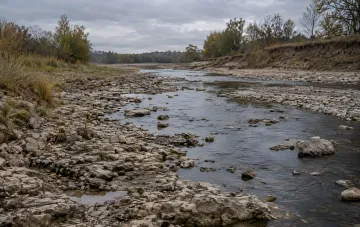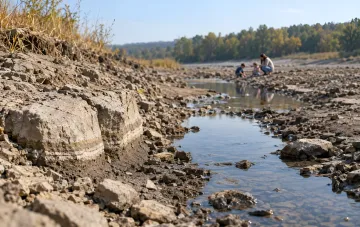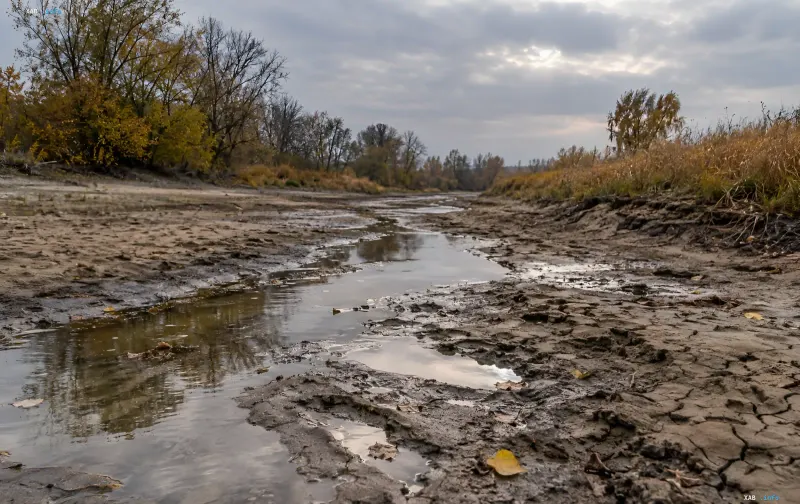
The Ukrainian Hydrometeorological Center (UkrHMC) has published an operational assessment of the water content of Ukraine's main rivers for October 2026. According to data presented at active hydrological posts, water levels on certain sections of water arteries have dropped to dangerous marks, while in a number of places, low water conditions—a hydrological drought—persisted and intensified. The assessment was carried out in accordance with the Regulation on the Procedure for Assessing and Informing about Low Water on Land Water Bodies of Ukraine, which defines the main and auxiliary criteria for recording the onset or threat of low water.
From Anomalous Excess to Critical Deficit
The water content picture for October 2026 turned out to be extremely heterogeneous. On the Inhulets River (Kryvyi Rih hydrological post), water content exceeded the norm by more than four times, reaching up to 415%. At the same time, on a significant number of other rivers, figures were below the long-term average: in the range of 50–78% of the norm, and in individual sections—31–44%. The most alarming situation developed where water content approached low water criteria, amounting to 21–27% of the norm. According to UkrHMC, it is on these watercourses that low water not only persisted but also intensified throughout the second month of autumn.
Environmental Flow under Threat
Center specialists emphasize that for most rivers whose hydrological regime affects water-dependent economic sectors and population water supply, monthly water content turned out to be below the long-term average of the driest month of the year. This is an auxiliary criterion, but exceeding it toward a deficit signals a systemic deviation from the norm. UkrHMC separately notes that the complex hydrological situation associated with maintaining water content below environmental flow values was observed throughout October and is critical for the functioning of river ecosystems. Water content within or above the norm of the driest month was recorded only on a limited number of watercourses.
Four Regions at the Highest Danger Level
As previously reported, critically low water levels were recorded on rivers in four regions of Ukraine, and UkrHMC declared the highest danger level there, which remains in effect until mid-November 2026. This means that in the coming weeks, the situation may either stabilize or worsen depending on precipitation and temperature regimes. The State Water Agency, in turn, previously explained whether low water could develop into a long-term problem for the country's water balance.
Context: Climate and Water Resources
The October drought fits into the broader context of changes in Ukraine's hydrological regime against the background of global warming. Experts point out that the combination of heat, heavy precipitation, and chronic water shortages is becoming a characteristic feature of recent seasons. At the same time, work is underway in the country to restore and clean water bodies—in particular, NAS scientists have joined projects to restore water bodies in Kyiv. The issue of drinking water safety, including control over pump rooms and bottling points, as well as Kyivvodokanal's explanations regarding tap water quality, remain in the focus of public attention amid the ongoing decline in river levels.