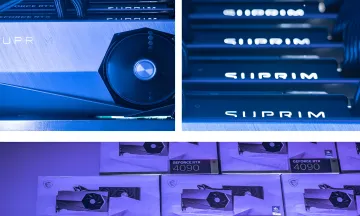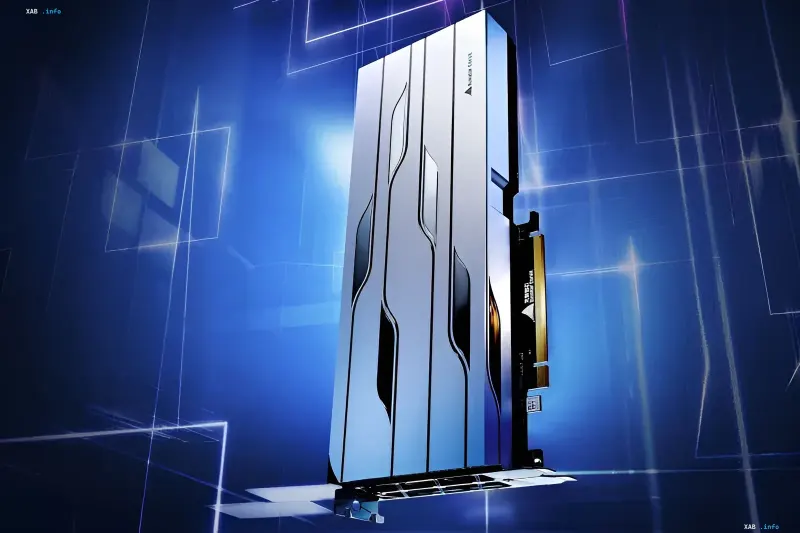
Chinese company Iluvatar CoreX has announced that its general-purpose graphics accelerator, the Tiangai 300, is capable of competing with the Nvidia H200—Nvidia's most advanced AI accelerator permitted for export to China under current US regulations. During a demonstration in Shanghai, the manufacturer presented benchmark results to journalists and showcased the hardware in operation. However, the company notes that detailed comparison conditions and calculation methodologies for some metrics have not been fully disclosed, limiting the possibility of independent verification of the claimed figures.
Image Generation: 100% vs. 87.5%
In one text-to-image generation test, the Tiangai 300 system successfully completed 100% of requests with a throughput of 0.101 images per second, while the H200 system handled 87.5% of requests at 0.086 images per second. At the same time, the Chinese accelerator's task completion time was 0.64 seconds longer. The company does not specify the criteria for successful request completion or the calculation methodology, so a direct comparison of these figures requires caution.
Third-Party Testing and Prefill/Decode Configuration
According to Iluvatar CoreX, testing conducted in July by Shanghai-based INESA showed that the Tiangai 300 system delivers 5% higher throughput per accelerator than the H200 system. The tests were run in a configuration with separated processing of input requests (prefill) and response generation (decode). The manufacturer claims the Tiangai 300 is the first Chinese general-purpose GPU to reach the H200 level in such tests.
LLM Workloads and Model Training
In another test, the company claims the Tiangai 300 outperformed the H200 by 15% in throughput when running the GLM-5.3 model on a Mixture-of-Experts (MoE) architecture with a 64K token context. For AI agent tasks with contexts ranging from 8K to 128K tokens, time-to-first-token was 10–30% lower. In a demonstration of training the open Alibaba Qwen3-32B model, an eight-card Tiangai 300 system using FP8 precision delivered 1.33 times higher effective throughput per card than an Nvidia H100 system.
Roadmap and Deployment Scale
Iluvatar CoreX is steadily closing the gap with Nvidia: in January, the company published a long-term architecture roadmap stating its intention to surpass the Nvidia Rubin platform within two years. According to the manufacturer, Tiangai series accelerators are already deployed in systems numbering tens of thousands of cards, accumulating valuable deployment and maintenance experience. The company is also expanding beyond cloud data centers to develop edge AI solutions: the Tongyang TY1200 computing system outperformed an Nvidia Thor T5000-based solution by 20% in certain large language model tests.
Limitations of Claimed Results
It is important to note that all cited figures pertain to selected workloads and do not prove overall superiority of the Tiangai 300 over its competitor. Success criteria, configurations, and methodologies for some tests have not been fully disclosed, and some tests were conducted by the company or its partner itself. Therefore, Iluvatar CoreX's statement should be viewed as a significant yet not fully verifiable step by the Chinese industry toward parity with Nvidia's flagship AI accelerators.