3D visualization specialist Simone Marulli from Marulli Studio has built a workstation featuring fifteen Nvidia GeForce RTX 4090 graphics cards operating simultaneously on a single motherboard. The system is designed for professional rendering of complex 3D scenes and, according to published data, has achieved record results in specialized benchmarks like OctaneBench and V-Ray 6. This project has become one of the most massive private multi-GPU workstation builds reported in specialized media outlets.
From One Card to Fifteen: Project Chronology
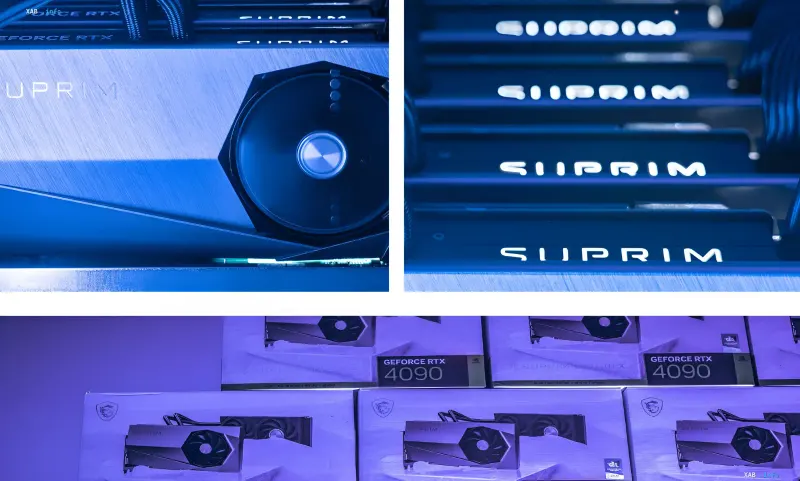
Work on the system began in December 2022 and took nearly a year. Marulli progressively increased the number of accelerators: starting from one graphics card, moving to two, then four, and eight, before finally bringing the configuration to fifteen. This step-by-step approach allowed him to fine-tune power delivery, cooling, and firmware as the load grew. Judging by published photographs, the station uses MSI GeForce RTX 4090 SUPRIM Liquid cards — a flagship liquid-cooled model critical for high-density layouts.
The "Mystery" of Housing 15 GPUs on a Single Board
The key technical puzzle of the build is how fifteen full-size accelerators were accommodated. Most modern workstation motherboards feature a maximum of seven full-size PCIe slots, making it impossible to install 15 cards through standard means. Marulli does not disclose architectural solutions or implementation details: exactly how he managed bandwidth, power delivery, and physical layout remains his secret. Nevertheless, the system's total specifications are impressive: each card features 24 GB of VRAM, providing a staggering 360 GB of VRAM for the entire station, while the total CUDA core count reaches 245,760.
Power Supply and Consumption Rivaling a Small Substation
To power the fifteen flagship accelerators, five 1,600W power supply units are used — totaling 8 kW. During active 3D rendering, the workstation's power consumption reaches nearly 8 kW, comparable to the load of multiple household appliances running simultaneously. This emphasizes that such configurations require not only a well-designed electrical grid but also serious engineering in current distribution and cooling.
Record-Breaking Benchmark Results
In the OctaneBench 2020.1.5 test with RTX mode enabled, the system scored 21,171.8 points, while the V-Ray 6 Benchmark result hit 172,615 vpaths. According to the author, both figures sit at the top of their respective public leaderboards, confirming the practical efficiency of the multi-GPU configuration for rendering tasks. For professional studios where render times directly impact project deadlines, such a workstation can drastically cut down complex scene calculation times.
Context: The RTX 4090 Market and Counterfeit Risks
The emergence of such powerful builds unfolds against the backdrop of an active flagship accelerator market, where specialized media outlets have reported fraudulent schemes involving the sale of RTX 4090 dummy cards on Asian marketplaces. This makes public case studies like Marulli's station especially valuable: they demonstrate real working configurations and help separate proven engineering solutions from market noise. For enthusiasts and professionals, the build remains a vivid example of how far GPU architecture can be scaled within a single system.