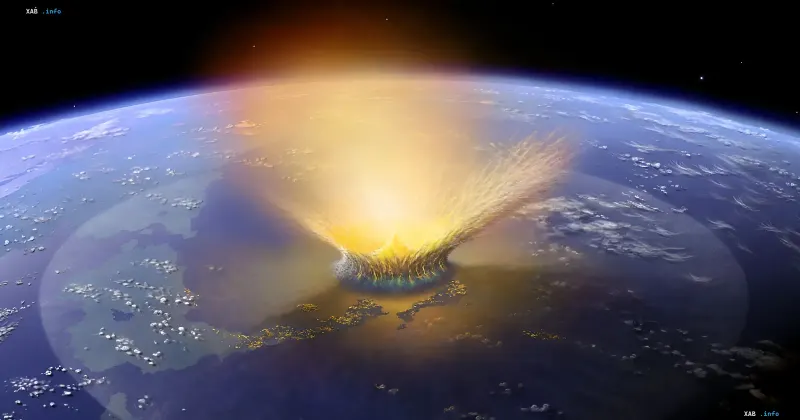
66 million years ago, Earth experienced one of the most catastrophic events in its history. A giant asteroid struck the territory of the modern Yucatán Peninsula, creating the Chicxulub crater, 180 kilometers wide. This collision led to a mass extinction that wiped out 75% of all species on the planet, including all non-avian dinosaurs. For a long time, science knew about this thanks to geological data, but a new study published in the journal Science Advances has forced researchers to radically reconsider the mechanism of the demise of prehistoric fauna.
An Alien from the Fringes of the Solar System
The results indicate that the dinosaur killer was not just a random rock, but an exceptionally rare visitor from the fringes of our Solar System. To understand the nature of the asteroid, scientists analyzed samples from a thin layer of clay deposited after the impact across the entire globe. This layer, known as the Cretaceous–Paleogene (K–Pg) boundary, is recognized as settled material ejected by the Chicxulub asteroid.
Advanced isotope analysis of nickel allowed the identification of the impactor as a CO chondrite. This type of cosmic rock represents one of the most primitive and pristine materials from the era of the birth of the Solar System. Only a tiny fraction of carbonaceous chondrites, constituting just 5% of all meteorites found on Earth, belong to the Ornan class (CO chondrites). The exact origin of the asteroid remains unknown, but previous studies suggest it may have come from a distant, debris-rich region at the edge of the Solar System.
The Myth of the Sulfur Cloud
For a long time, the prevailing theory stated that gases released from the asteroid, especially sulfur, played a key role in the onset of the "impact winter." It was believed that sulfur effectively blocked sunlight, causing rapid cooling of the planet. However, new data suggest the opposite.
CO chondrites contain relatively low concentrations of volatile elements such as water, carbon, zinc, and especially sulfur. Researchers found that this asteroid would have released approximately half the amount of sulfur estimated by previous studies. This casts doubt on the role of sulfur as a decisive factor in the extinction.
Philippe Claeys, a planetary scientist and professor at the Free University of Brussels in Belgium, who participated in the study as a visiting professor at the University of British Columbia, explained the essence of the discovery:
"This does not change our theory about what caused the extinction event, but it makes it less likely that the sulfur contained in the impactor was the decisive factor. The fine dust ejected into the atmosphere would have been the main cause".
Dust Instead of Gas
According to new data, the climatic shift that doomed the dinosaurs was primarily caused by dust ejected into the atmosphere during the collision of the asteroid with Earth. Before the material settled into what subsequently became the K-Pg layer, it was suspended in the atmosphere. Along with gases released by the asteroid itself and soot from colossal forest fires, this caused an impact winter that blocked sunlight, rapidly cooled the planet, and destroyed ecosystems.
The collision with such a rare and distant projectile truly shows how unlucky the dinosaurs were. Claeys and his colleagues believe that their work paves the way for further research into the link between the Chicxulub impact and the mass extinction at the end of the Cretaceous period. Even after 66 million years, it is clear that there is still much to learn about this world-changing asteroid.