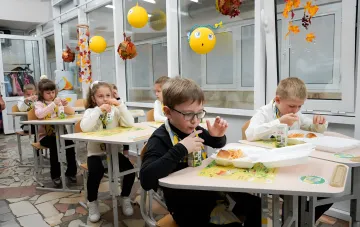

The Ministry of Education and Science of Ukraine, in a blitz interview for RBC-Ukraine, confirmed that the organization of the educational process for the 2026/2027 school year is built around one key principle: taking into account the security situation in each individual administrative-territorial unit. According to representatives of the ministry, the most optimal form of learning for students in Ukrainian schools remains in-person, but it is precisely the presence and quality of shelters that form the basis of a full-fledged in-person educational process. The working format of a specific institution is not set centrally but locally — by the pedagogical council of the institution, which reviews and approves the form of learning taking the local situation into account.
Decisions are made locally: the role of the pedagogical council and the parent community
The Ministry of Education and Science (MES) emphasized that when preparing institutions for the new school year, special attention must be paid to ensuring safety and readiness for possible air raids. The ministry separately stressed the need for cooperation among military administrations, local self-government bodies, school leaders, and the parent community. It is precisely this coordination, according to the ministry's logic, that allows the format of classes to be flexibly adapted — from fully in-person to hybrid — depending on how stable the security situation is in a given region at the start of and during the school year.
Shelters: 90% of in-person schools are ready, 10% need repair
As of the end of August 2026, according to MES data, 90% of Ukraine's general secondary education institutions operating in in-person format have shelters. The ministry clarified that 10% of these are limited-use shelters, meaning those that require major repair or reconstruction. According to ministry representatives, 5 billion hryvnias were allocated this year for the construction and outfitting of shelters in schools. This figure, in the ministry's assessment, reflects the scale of the state program to protect educational infrastructure amid ongoing air raid alerts.
Energy resilience: 500 million hryvnias and a November 15 deadline
A separate direction in preparing for winter, the MES called ensuring the autonomous operation of educational institutions during prolonged power outages. In 2026, the government, according to ministry data, provided nearly 500 million hryvnias in subventions to ensure the energy resilience of educational institutions. All activities under this subvention, as the ministry summarized, must be completed by November 15, 2026 — that is, before the active phase of the autumn-winter period, when the risk of prolonged blackouts traditionally rises.
Contradictory data
There are discrepancies between the official statements of the MES and the data of a number of Ukrainian media outlets regarding key figures on school readiness. In the blitz interview for RBC-Ukraine, the ministry reported that 90% of general secondary education institutions operating in in-person format have shelters. At the same time, the outlet UNN, referring to preparations for the school year, gives a different estimate: according to its data, shelters exist in 82% of schools (and in 83% of kindergartens), while up to 70% of schools will teach in in-person mode at desks. The difference in figures (90% vs. 82%) may be explained by different bases of calculation — in one version only institutions already operating in in-person format are counted, while in the other the entire school fund is included, including those switching to hybrid or remote mode. Nevertheless, both versions confirm that a significant share of schools (from 10% to 20%) still lack fully suitable shelters, and part of the learning may take place in a non-fully in-person format.
Bottom line: safety as a condition for in-person learning
A summary of the MES positions allows the conclusion that in the 2026/2027 school year the state is betting on in-person learning as the priority format, but its actual implementation will be uneven across regions. The key limiting factors remain two: the presence of suitable shelters and the ability of schools to operate autonomously during power outages. The allocated 5 billion hryvnias for shelters and about 500 million hryvnias for energy resilience, along with the set deadline of November 15, 2026, form the time horizon by which schools must complete the main preparation for the autumn-winter period.