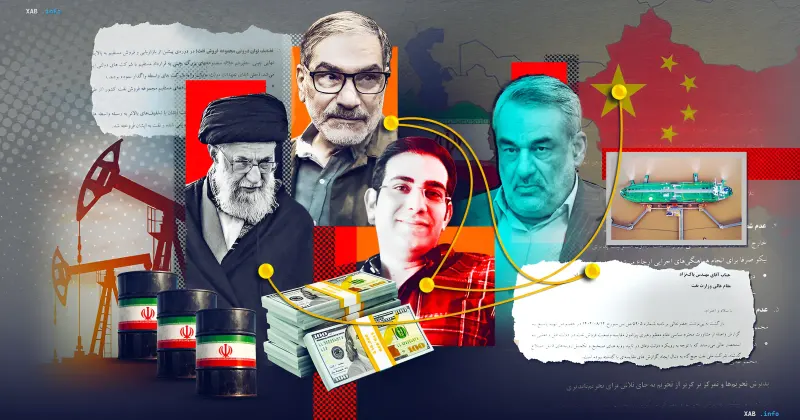
A confidential document obtained by Iran International and sources within Iran's Ministry of Petroleum indicate that Tehran is utilizing oil terminals and storage facilities in China to keep sanctioned tankers operating despite Washington's restrictions. Essentially, this involves shifting part of the logistics beyond the reach of American pressure: vessels formally remain under sanctions but gain the ability to offload and transfer cargoes through Chinese infrastructure. Simultaneously, as U.S. Central Command (CENTCOM) announced on November 7, a new task force called «Iron Gate» has been formed in Tampa, comprising about 20 civilian and military personnel coordinating with other agencies to track weapons shipments and other illicit flows across Iran's land borders and the Caspian Sea.
Chinese infrastructure as a bypass channel
According to the leak, terminals and storage facilities in the PRC have become a key element of the scheme, allowing Iranian tankers to continue operations where direct shipments under U.S. sanctions would be impossible. This is especially significant given that, according to CENTCOM estimates, the naval blockade has already prevented over $25 billion in crude oil exports. It is this revenue gap, sources argue, that is driving Tehran to seek alternative channels—including through third countries with developed oil infrastructure capable of receiving and processing cargoes without directly falling under American restrictions.
Iron Gate task force: capabilities and limits
Analysis shows that «Iron Gate» adds coordination capacity for Washington, but the announcement itself contains no signs of new authorities to board ships in the Caspian Sea or access neighboring states' ports. According to a June assessment by the Center for Strategic and International Studies (CSIS), Iran needs imported machine tools, electronics, and engines to restore its military-industrial potential, with the Caspian and Pakistan viewed as alternatives to disrupted procurement through the UAE. Thus, the group's real effectiveness depends less on Washington's ability to track specific shipments and more on whether governments, banks, and suppliers can be persuaded to halt facilitation before goods ever reach the region.
The Caspian corridor and the Russia factor
The most complex piece of the puzzle remains Russia: Moscow's military cooperation with Iran gives it grounds to keep transport links open, limiting Washington's prospects for cooperation on the key northern route. In October, Yorktown Institute analyst Nikita Smagagin described the expansion of Caspian trade amid vessel shortages, port capacity constraints, and rising freight rates. This corridor gives Tehran breathing room but cannot replace the southern gateway; at the same time, congestion, shallow depths, and seasonal conditions can slow deliveries without any American intervention, complicating the very assessment of enforcement effectiveness.
Regional partners: between pressure and pragmatism
Kazakhstan clearly demonstrates the contradiction between financial pressure and regional transport ambitions: in May, Deputy Prime Minister Serik Zhumangarin stated that settlement risks had halted contracts with Iran, yet a month later, Astana signed an agreement for a logistics terminal at Iran's Shahid Rajaee port. Although the port is located on Iran's southern coast, the project reaffirms Astana's broader interest in maintaining transit ties through Iran. Azerbaijan, in turn, suspended freight crossings on March 5, 2026, further narrowing available routes. In September 2024, the U.S. Department of State already sanctioned Russian shipping companies that it said were transporting Iranian military equipment across the Caspian to Russia; these measures set an enforcement precedent targeting suppliers rather than just operators.
What success actually means
A crucial distinction is that restricting military supply does not require shutting down ordinary trade, and growing trade volumes do not in themselves mean the task force has failed. Individual shipments of critical equipment that Iran cannot replace on its own are more vulnerable to interception. However, if other suppliers back down while Russian routes remain open, the pressure may simply increase Tehran's dependence on Moscow, narrowing its room for maneuver and preserving the very military partnership Washington aims to weaken. In this scenario, economic dependence and military supplies will not necessarily move in the direction envisioned by American strategy.