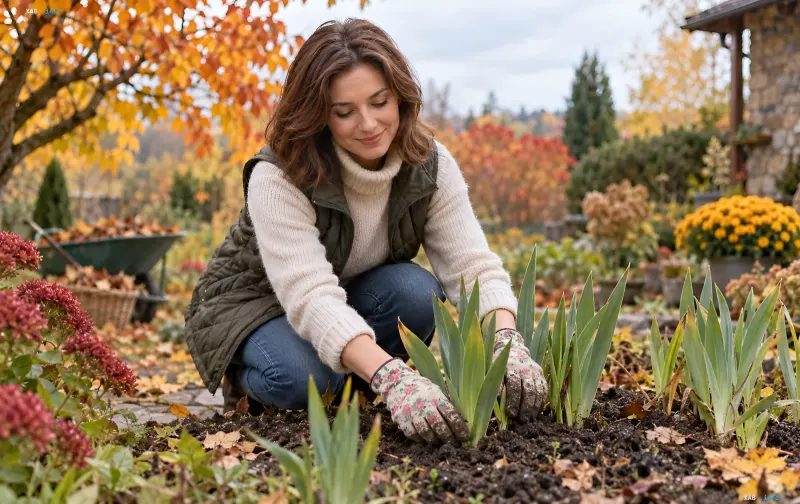
November is not the month when irises require radical interventions. According to the University of Wisconsin and the RHS, the gardener's primary task during this period is to keep the rhizomes dry and allow the plants to complete their natural preparation for cold weather. Young plantings that have not yet rooted, as well as flower beds where water stagnates after rains, need special attention in November. Healthy green leaves should not be cut off simply because November has arrived: they continue to participate in photosynthesis and nourish the root system. The condition of the foliage serves as the guide for pruning, not the calendar.
What to Remove and How to Manage Foliage
Ask Extension specialists explain: the leaves of Siberian irises can be completely cut off after natural dieback, which usually occurs after the first frosts. For bearded irises, all foliage that has died off after frosts is also removed to reduce the number of disease pathogens capable of overwintering on plant debris. However, without waiting for complete foliage dieback, dry flower stalks and leaves showing signs of disease must be removed now. Work with sharp, clean scissors or pruners, taking care not to damage the rhizomes. All cut parts are removed from the flower bed along with weeds and fallen leaves accumulated around the bushes—according to REGIONS, damp organic matter left on the bed turns into a breeding ground for rot and fungal infections.
Drainage: The Main Survival Factor for Bearded Irises
Bearded irises tolerate prolonged waterlogging poorly, and water stagnation kills rhizomes more often than frost does. According to RHS recommendations, these plants need well-drained soil, and the upper part of the rhizomes should remain partially exposed. After every rain, it is worth checking whether water is pooling at the base of the bushes. If drainage is blocked by matted leaves or other debris, the obstruction must be removed. It is strictly not recommended to cover the rhizomes with a thick layer of soil "for protection against dampness"—this creates a compress effect and accelerates rotting.
Mulching and Covering: When and With What
The need for cover depends on the winter hardiness of the specific species and variety, the age of the planting, and local conditions. The University of Wisconsin recommends mulching young bearded iris plantings after the soil freezes, if a snow cover has not formed. Such mulch protects rhizomes from damage during alternating freezing and thawing cycles; it is removed in spring. For light winter protection, Utah State University suggests using straw or evergreen boughs. In cold regions, light cover may also be useful for established plantings. It is important not to cover plants prematurely and not to tamp the material into a dense, wet layer: temporary winter cover should not turn into permanent burial of the rhizomes.
What Not to Do in November
Scheduled fertilization of bearded irises before winter dormancy is best postponed until the next season. In a Washington State University material, applying a small amount of low-nitrogen fertilizer is mentioned as a post-flowering task, not as a mandatory part of November preparation. Dividing rhizomes in November is also not recommended: after transplantation, plants need time for root recovery, and experts advise leaving about 4 to 6 weeks for rooting before severe frosts. The optimal timing for division is July or August for bearded irises and early spring or late end of summer for Siberian ones. If there is not enough time before frosts, scheduled division is postponed. According to Glavred, in most regions, division is carried out in August–September, 6–8 weeks after flowering ends, and repeated every 4–5 years.
Bulbous Irises: A Separate Cycle
Reticulate and Dutch irises, which belong to bulbous types, have a fundamentally different development cycle. Experts note that their leaves should only be removed after natural dieback, and cutting green foliage according to the calendar is unnecessary. Bulbs are planted in autumn in well-drained soil, but this is a separate agrotechnical task rather than an exception to the general rules. The suitability of November for planting bulbous irises should be assessed taking into account the specific species and local climatic conditions.