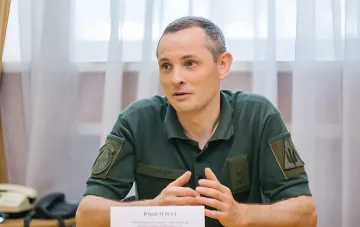
In the podcast «TSЕ BAZA», Viktor Pavlov, an officer of the Unmanned Ground Systems (UGS) battalion of the 3rd Assault Brigade and founder of the UGS school, spoke about the possibility of delivering ground robots over long distances — including deep into enemy territory, all the way to Moscow. According to his assessment, such a task is technically feasible, but its implementation rests on a number of engineering and tactical limitations, without which deployment turns into a risky operation. The conversation became a continuation of a broader discussion on how Ukrainian units are scaling the use of robotics beyond the direct line of contact.
Two key factors: carrier and communication channel
Pavlov broke down the task into two mandatory components. The first is the carrier: the unmanned ground system must be physically delivered to the deployment site, and without a suitable delivery vehicle, the very idea of deployment makes no sense. The second is a stable communication channel that allows the operator to control the system remotely. Both factors, according to the officer, are fundamentally solvable, which is why he calls the scenario of long-distance UGS deployment «quite real». At the same time, he emphasizes that we are talking about a combination of conditions rather than a single solution: a failure of any of the elements makes the operation ineffective.
The landing problem and the role of the parachute system
The landing phase deserved special attention in the podcast. Pavlov notes that dropping FPV drones for so-called «deep strikes» against rear targets is technically simpler, whereas the ground robot itself must land and not break upon contact with the surface. The use of parachute systems, he says, complicates the design and the process: the robot must withstand the impact upon landing, and the parachute adds mass, dimensions, and additional points of failure. Thus, even with a carrier and communications, the issue of the system's survivability at the landing stage remains critical.
The risk of carrier destruction by air defense systems
The third, as Pavlov formulates it, limiting factor is the enemy's air defense system. The carrier used to deliver the unmanned vehicle can be shot down by air defense long before the drop or deployment of the robot. This means that planning such an operation requires not only engineering preparation, but also an assessment of the air situation, route selection, and the application window. The combination of these risks, according to the officer's assessment, does not make the scenario impossible, but moves it from the category of «simple» to the category of carefully prepared operations.
Practical precedents: from Operation «Vivaldi» to carrier drones
The discussion about UGS deployment is not just theoretical: in autumn, the tactic was applied in practice for the first time. According to available data, in September, the NC13 strike UGS unit of the 3rd Army Corps during Operation «Vivaldi» deployed kamikaze robots from heavy bombers more than 10 kilometers deep into the rear. In parallel, it was reported that fighters of the Alter Ego battalion of the 93rd Brigade developed a technology for high-precision deployment of a combat UGS dozens of kilometers from the contact line using a drone as a carrier. These precedents confirm that the transition from concept to combat use has already taken place, and Pavlov's discussion in the podcast actually describes the logical development of this tactic over even greater distances.
What this means for future tactics
Together, the officer's statements and the recorded precedents indicate the formation of a steady trend — the delivery of ground robotics deep into the rear without landing live infantry. The key bottlenecks remain three: a reliable carrier, a stable control channel, and protection against air defense on approach. While these elements are being solved separately in different units, the mass use of deployed UGS at strategic distances, including against large cities, remains a task that requires further engineering and tactical elaboration. Nevertheless, as Pavlov emphasizes, none of these barriers is insurmountable, making the scenario a working planning subject rather than a hypothesis.