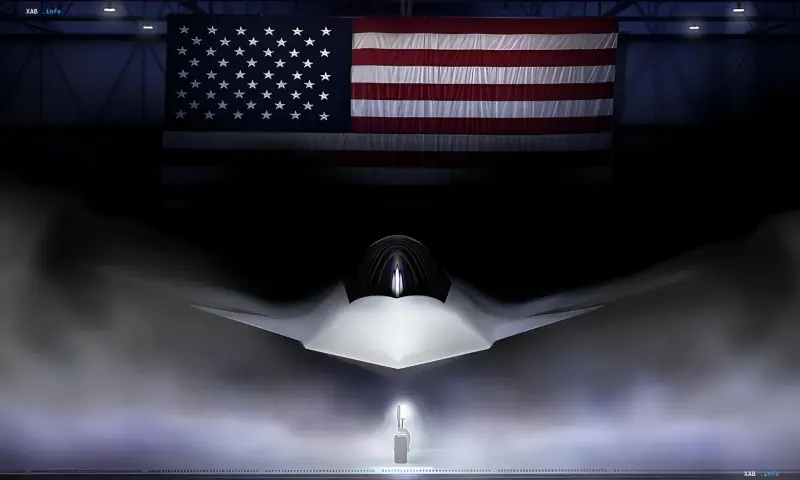
According to the Jerusalem Post, the Israeli side received information for the first time about the prospective American fighter F-47 during negotiations related to the memorandum of understanding with Iran. This came as a surprise to Tel Aviv: the program is shrouded in an extremely high degree of secrecy, and even among Washington's allies information about it was shared only in fragments. Currently, the Israeli Ministry of Defense and the Israel Defense Forces (IDF) are preparing a request to the Pentagon to obtain information on the F-47's capabilities, as well as to clarify the status of ongoing F-35 and F-15 deliveries.
Washington's Shift in Course: From F-22 to F-47
For many years, the US has consistently refused to sell F-22 Raptor fighters to any foreign state, thereby maintaining unconditional air superiority. However, despite the closed nature of the F-47 program, senior White House officials, according to available information, have allowed that Japan may be permitted to participate in the project. Israeli defense officials are not yet sure whether these signals were intended as a demonstration against the backdrop of growing tension with China, or whether they reflect a genuine shift in Washington's policy opening access to sixth-generation technologies for allies.
Technical Specifications and Sixth-Generation Ambitions
The F-47 is positioned as a sixth-generation fighter with a unique-in-the-world low-observable profile and aerodynamic design. The aircraft is to carry significantly more armament than the F-35, be equipped with advanced artificial intelligence systems, and control robotic complexes, including unmanned aerial vehicles housed inside the fuselage. Western experts allow that, depending on the configuration, the F-47 may be operated remotely. Particular emphasis is placed on integration with combat systems in the air, at sea, on land, and in space, as well as on reducing maintenance costs compared to the F-22 and F-35.
Engine Problems and Delays
The key bottleneck of the program has been engine development. One of the Pentagon's requirements is the ability to generate thrust without using fuel, which is supposed to increase the range to at least 2,000 km. It is precisely the specificity of these requirements compared to previous generations that led to a number of difficulties. According to American media, the first test flights of the F-47 are expected in 2028, and the final cost of each aircraft will depend on the size of the Pentagon's order and Washington's policy on the participation of other countries.
Contradictory Data
Significant uncertainty remains around Washington's motives. On the one hand, White House hints about possible Japanese participation are interpreted as a genuine review of the long-standing policy of closedness, which would open the doors to Israel as well. On the other hand, Israeli analysts point out that these signals may be purely diplomatic in nature and addressed to Beijing rather than to allies. Moreover, neither the Pentagon nor the White House has officially confirmed either the fact of negotiations with Israel on the F-47 or the technical parameters, which are based mainly on American media data and anonymous sources. Thus, the version of a 'genuine shift' and the version of a 'diplomatic signal' are currently equally valid and have not been refuted by one another.
What This Means for Israel
Tel Aviv intends to conduct an initial assessment of US policy regarding the F-47 to understand whether Washington's approach differs from the previous restrictions on the F-22. If ally access to the program is formalized, this could change the balance of aviation armaments in the Middle East and give Israel the opportunity to participate in shaping sixth-generation standards. For now, everything remains at the level of requests and preliminary assessments, with key decisions resting with Washington, which continues to keep the program under maximum secrecy.