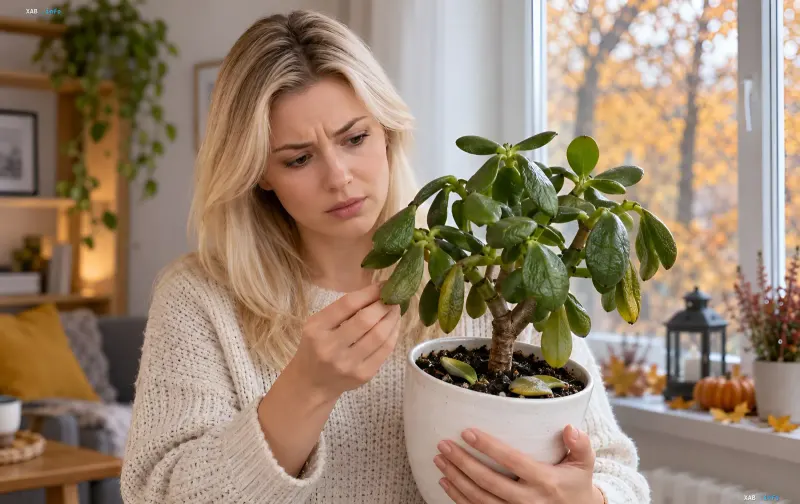
In late autumn, owners of indoor succulents often notice that the leaves of the jade plant (Crassula) lose their firmness, wrinkle, and begin to drop. The intuitive reaction is to water the plant even more abundantly; however, as botanists emphasize, additional watering in many cases only worsens the problem. Crassula belongs to succulents that store water in their fleshy leaves and stems, so the loss of turgor can indicate either substrate dryness or excessive moisture leading to root system decay.
Diagnosis: Why Leaves Wrinkle
Specialists at South Dakota State University recommend checking soil moisture not only on the surface but also at depth before watering. If the leaves are wrinkled while the soil remains wet, a likely cause is root damage, which stops the roots from absorbing water normally. In this situation, heavy watering will not only fail to help but will also accelerate the development of rot. A brown stem hue does not always indicate disease: in a mature Crassula, the stem naturally turns woody. The dangerous sign is precisely the softening of the tissue, not the change in color.
Overwatering Is Crassula’s Main Enemy
An article from Oregon State University points out that excessive watering is one of the main causes of root and stem rot in succulents. If the stem loses its firmness and the leaves continue to drop, the root system must be checked. Further actions depend directly on soil moisture and the general condition of the plant: moderate watering is required for dryness, while drying out the substrate and, if necessary, reputting with the removal of damaged roots is needed for overwatering. University of Maryland specialists recommend letting the substrate dry out between waterings for indoor plants with damaged roots and considering leaf condition when determining watering frequency.
How to Save Crassula If Rot Has Already Set In
If the base of the stem is severely rotted, saving the entire plant is not always possible. In this case, experts advise cutting healthy apical shoots for further rooting. According to recommendations from the University of Wisconsin, cuttings should be left in a dry place for a few days so that the cut areas heal and dry out. After that, they are planted in a well-drained, non-waterlogged substrate. Although cuttings root best in the summer, Crassula can be propagated throughout the year — the main thing is to maintain a moderate watering regime and adequate lighting.
Winter Watering Regime: Less Water, More Control
The Royal Horticultural Society (RHS) indicates that from November to early March, most indoor succulents require significantly less water than during the warm period. In this season, it is necessary to avoid overwatering while preventing severe wrinkling of the plant from drying out. The watering frequency depends on indoor temperature, light levels, pot size, and the rate at which the soil dries. If the substrate is still moist and the leaves show no obvious signs of dryness, it is better to postpone the next watering. This approach keeps the Crassula healthy throughout the winter and avoids typical autumn-winter root system problems.