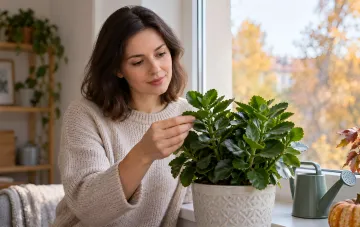
With the onset of autumn, many owners of indoor purple shamrock (Oxalis triangularis) watch with concern as the characteristic purple or green triangular leaves gradually fade, lose their elasticity, and dry out. In November, when the weather turns colder outside, the picture worsens: the plant looks as if it has been destroyed. However, according to North Carolina State University, dropping leaves in autumn is generally a natural part of the oxalis life cycle. The plant enters a dormant state, storing water and nutrients in its underground rhizomes, which will allow it to recover in spring. Nevertheless, similar symptoms can also indicate serious problems: overwatering or underwatering, lack of light, or root damage. That is why it is important to be able to distinguish between physiological dormancy and a pathological condition.
Signs of Natural Dormancy and Warning Signals
Before taking any action, it is necessary to carefully assess the condition of the plant. A natural dormancy period is indicated by the gradual, uniform dying off of leaves without signs of rot, the absence of an unpleasant odor from the soil, and the preservation of rhizome firmness. If the leaves turn yellow unevenly, soft dark spots appear on the stems, and a musty smell comes from the pot, this is a reason to suspect rot. Experts at the University of Maryland emphasize that healthy indoor plant roots are usually light and resilient, while rot-damaged areas become dark and soft. At the same time, it is important not to confuse thin roots with the oxalis rhizomes themselves — they may have a brown color, and assessing their condition solely by color is incorrect. The key criterion is tissue density: healthy parts should remain firm, without signs of decomposition.
Watering and Drainage: The Main Cause of Problems
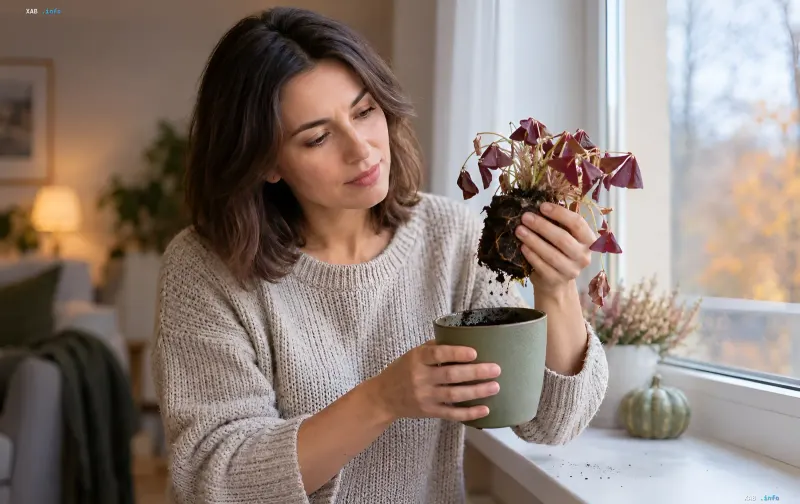
If the soil in the pot is constantly wet and the plant continues to wither, you should first check the drainage hole: water must flow freely out of the pot. If rot is suspected, it is recommended to gently remove the oxalis along with the soil ball and inspect the underground part. For replanting, a potting mix for indoor plants with the addition of perlite is suitable, as it makes the soil looser and improves root aeration. If most of the underground organs are damaged by rot, saving the plant will be difficult, but even small healthy fragments of rhizomes are capable of producing new shoots. At the same time, if the oxalis is healthy and the soil drains well, urgent replanting is not required — it is enough to normalize the watering routine.
Winter Care: Light, Temperature, and Watering Regimen
Winter care for oxalis depends directly on its condition. A plant that continues to produce leaves does not need to be forced into dormancy. The University of Missouri recommends providing oxalis with bright indirect light, moderate temperature, and protection from fluctuations: the pot should not be placed directly near a hot radiator or in the path of a cold draft from an open window. In winter, the soil dries out more slowly, so before each watering, its moisture level must be checked to a depth of two to three centimeters. If new shoots appear among the old leaves, care continues as usual, adjusting the amount of water taking into account the temperature and humidity of the substrate.
When Leaves Die Off: Rules of Complete Dormancy
If the leaves are gradually dying off but there are no signs of rot, watering must be reduced. The New York Botanical Garden advises that after the above-ground part has completely dried, remove the dead leaves and move the pot to a cool, dark place. During the period of complete dormancy, botanical garden experts recommend keeping the soil dry and not fertilizing the plant. At the same time, recommendations regarding moisture during dormancy vary slightly: some experts advise keeping the substrate barely moist. The fundamental rule agreed upon by all sources is not to return to heavy watering until the plant resumes active growth. If the oxalis still has living leaves, do not rush to move it into the dark — you need to wait for the complete death of the above-ground part. It is strictly forbidden to leave the pot on an open balcony during frosts: a cool room for winter dormancy must not be freezing.
Transplanting and Propagation During Dormancy
Over time, the substrate in the pot becomes compacted, and the rhizomes fill almost the entire volume space. In this case, it is advisable to plan replanting for the period of growth resumption, when the plant has already produced its first fresh shoots. University of Wisconsin experts note that during dormancy, oxalis can also be propagated by dividing the underground organs: healthy parts of the rhizomes are carefully separated and planted in small groups in pots with a well-drained substrate. At the same time, there is no need to immediately choose a too spacious container — oxalis has a relatively shallow root system and develops better in compact pots where the rhizomes are crowded and actively branch out. Properly organized wintering and timely replanting will allow the plant to delight owners in spring once again with bright triangular leaves that fold up in the evenings and open up again in the mornings — a natural reaction to changing lighting that requires no intervention.