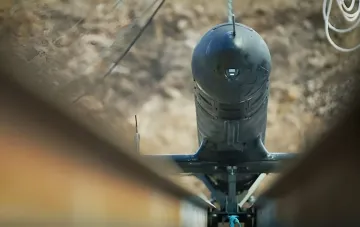
According to RBC-Ukraine, ahead of the autumn-winter period the Russian Armed Forces are carrying out a mass transition to jet-powered modifications of 'Shahed' drones, 'Banderoil'-type products, and other cost-reduced analogues of cruise missiles. This was stated in a comment to the outlet by Tymofiy Yurkov, co-founder of the Contra-Drone company, who emphasized that this tactical change significantly complicates the interception task for Ukraine's air defense and electronic warfare systems. The expert noted that this is not a matter of isolated tests, but a systematic reorganization of the aerial component of attacks, which is already being observed along the approach corridors.
Jet Thrust: A Shift in the Paradigm of Aerial Attack
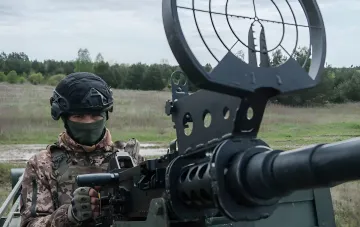
The key element of the new tactics, according to Yurkov's assessment, is precisely the transition to jet thrust. Unlike classic propeller-driven 'Shaheds,' which fly at a speed of around 180 km/h, jet-powered modifications and 'Banderoil'-type products demonstrate significantly higher dynamics. This turns them from slowly moving targets into objects that cover substantial sections of their route in mere seconds. For air defense forces, this means a radical reduction in the time available for detection, identification, and the decision to intercept. Classic mobile fire groups, armed with small arms and searchlights, become, in the expert's words, practically useless in a sky saturated with jet-powered targets: interception falls to surface-to-air missile systems, man-portable air defense system (MANPADS) crews, and electronic warfare means.
Speed vs. EW: The Suppression Window Shrinks
The main problem associated with high-speed targets is the critical reduction in the time during which a missile or drone remains within the operating zone of electronic warfare stations. In that short interval while a fast target flies past a jamming station, its onboard navigation simply does not have time to accumulate enough error to deviate significantly from the set course or to disrupt the execution of its combat mission. Yurkov emphasizes that the only effective response from EW is a large-scale increase in the number and density of such systems along the approach corridors. Only the formation of a continuous, echeloned field of jamming along the entire direction of movement can create sufficient exposure for guaranteed suppression of navigation, disruption of communication networks, and the breakdown of precise targeting on infrastructure objects.
CRPA Antennas and Mesh Networking: The Enemy Closes Its Vulnerabilities
The situation is further complicated by Russia's active deployment of 16-channel jamming-resistant CRPA antennas on board its munitions, as well as the use of mesh networking for interaction between individual elements of an attack. CRPA antennas with adaptive beamforming allow onboard navigation to operate in conditions of a dense jamming field, while the mesh architecture provides communication fault tolerance: even when some nodes are suppressed, the network continues to function. This means that for the guaranteed destruction of such a target, what is required is not point suppression, but precisely echeloned and continuous suppression over the entire route — from the border to the infrastructure object.
Winter Hits Optics, but Not Electronics
Autumn and winter bad weather, according to Yurkov's assessment, hits above all the optical observation channels. Low cloud cover at an altitude of 100–150 meters and dense fog leave MANPADS operators only seconds to visually acquire a jet target with a thermal seeker before it disappears again into the clouds. For EW systems, by contrast, frost and bad weather are not a critical obstacle: radio waves penetrate clouds and fog of any density, so in 'blind' weather the importance of electronic protection only increases. At the same time, winter adds operational friction: the load on power systems and generators increases, the rotating mechanisms of antenna complexes require constant maintenance against icing, and very dense wet snow creates additional attenuation of high-frequency signals. Nevertheless, as a system, EW, in the expert's conclusion, remains the most reliable all-weather echelon, operating independently of optical visibility.
'Dnipro-T' and the Risk of Mass Scale
An additional load on Ukrainian air defense, according to RBC-Ukraine sources, is created by Moscow's plan to increase production of the 'Dnipro-T' ballistic missile to 14,000 units by 2027, with up to two thousand munitions expected to be produced by the end of 2026. The outlet's sources consider the main risk to be precisely the mass scale of this weapon: high speed and long range, combined with thousands of units, are capable of creating an additional load on the air defense system in addition to the stream of 'Shaheds,' cruise, and ballistic missiles. Thus, the Ukrainian side faces the task of simultaneously countering several types of threats with fundamentally different characteristics — from slow propeller drones to high-speed jet targets and ballistic missiles.