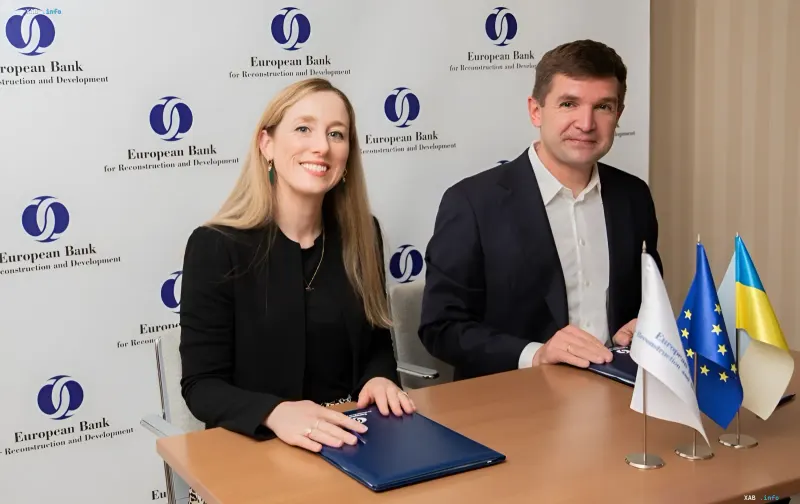
The agrarian-industrial group Kernel and the European Bank for Reconstruction and Development (EBRD) have signed a grant agreement worth €1 million, aimed at developing the company's programs in the field of human capital. This is reported by RBC-Ukraine, citing a press release from Kernel. The signing took place against the backdrop of ongoing hostilities and an acute shortage of qualified personnel in key sectors of the economy. Both parties emphasize that investing in people is a necessary condition for Ukraine's recovery and must be carried out now, with an eye on the long-term perspective.
Four Laboratories to Train 600 Specialists
The first and most extensive component of the project will be the creation of modern training laboratories in four vocational-technical colleges in Ukraine — in Odesa, Poltava, Kropyvnytskyi, and Starokonstantyniv. These laboratories will be used to train skilled workers in trades that are critical for the agricultural sector, industry, and renewable energy: electricians, production automation specialists, and other technical personnel. The laboratories are planned to be equipped with state-of-the-art equipment, enabling students to acquire real practical skills and meet the demands of the modern labor market. According to the parties' estimates, over five years, approximately 600 qualified young specialists will be trained at these laboratories, forming the foundation for the recovery of the regional economy.
Inclusivity and Support for Veterans
The second component of the grant program provides for the modernization of Kernel's production facilities in line with international principles of barrier-free access and universal design. The company is implementing all solutions in direct collaboration with veterans, so that the infrastructure meets the real needs of people returning to civilian work. This work is part of a comprehensive veteran support program, including the adaptation of workplaces, as well as physical and psychological reintegration. Kernel's HR Director Natalya Teryakhina noted that for the company, the partnership with EBRD is "not only financing, but above all a synchronization of values," and that the trust of an international financial institution of this caliber in the implementation of strategic social projects during wartime is a significant signal for the market.
Grant Mechanics and Donor Support
The initiative is being implemented under the EBRD's Human Capital Investment Incentive (HCII) grant program, launched in 2024 to support Ukrainian companies in addressing the workforce challenges caused by the war. The program provides co-financing of investments aimed at creating employment opportunities, developing professional skills, and improving the accessibility of work infrastructure. Donor support for the specific EBRD–Kernel collaboration is provided by the TaiwanBusiness-EBRD Technical Cooperation Fund. EBRD Director for Economics and Gender Policy Sonia Jordan-Kirwan stated that the bank supports projects that help Ukrainian businesses strengthen resilience and invest in the country's future, and that investments in accessibility and inclusive technical education "create new opportunities for people, strengthen business resilience, and demonstrate to future international investors the maturity of Ukrainian companies."
Context: Not the First Project of Its Kind
The signed agreement opens a new stage in the cooperation between Kernel and EBRD on human capital development. Notably, this is not the group's first social project of this nature: previously, Kernel, together with We build Ukraine and "Content. Policy Analysis Center," launched Ukraine's first School of Public-Private Partnership (PPP) for local communities, whose goal is to teach local authorities to prepare economically sound projects for regional recovery and development in order to attract private and international capital. Thus, the €1 million grant fits into the company's broader strategy of combining commercial activity with systematic social investments in wartime conditions.
Contradictory Data
Open sources simultaneously reference two distinct financial interactions between Kernel and EBRD, which in some publications may be erroneously conflated. The first is the grant agreement under review, worth €1 million under the HCII program (confirmed by RBC-Ukraine and Interfax-Ukraine). The second is a $45 million loan that Kernel obtained from EBRD for the construction of a solar power plant (reported by Mignews and Ukrnews). These two projects differ in amount, currency, financing mechanism (grant versus loan), and purpose (human capital versus energy infrastructure). The provided materials contain no discrepancies in the figures or dates for the €1 million grant itself — both verified sources (RBC-Ukraine, Interfax-Ukraine) cite identical data.