As it approached Sumy, the passenger train on the Kiev–Sumy route came under attack by two Russian "Shahed" drones. According to Ukrzaliznytsia, the train was stopped in advance at a station by the company's monitoring team, after which the passengers, the train crew, and the locomotive crew were evacuated before the strikes were delivered directly onto the carriages. This was announced on Facebook by Oleksandr Pertsivskyi, Chairman of the Board of JSC "Ukrzaliznytsia," in a post cited by RBC-Ukraine.
Timeline and course of the attack
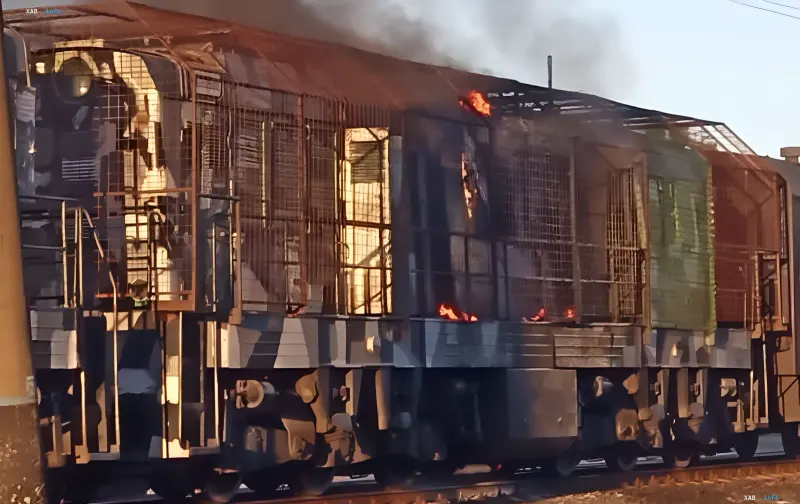
The key factor in preventing casualties was the work of Ukrzaliznytsia's monitoring team, which stopped the train at a station before the drones arrived. Once the train was stopped, the evacuation of people from the carriages began. Only after the passengers and crews had left the carriages were the strikes delivered by the two "Shaheds" — the train caught fire on the spot, as evidenced by the open flames and columns of smoke rising above the damaged carriages. Ukrzaliznytsia emphasizes that it was precisely the timely response of the monitoring group and the passengers' compliance with the train crew's instructions that prevented any loss of life.
Evacuation and passenger transfer
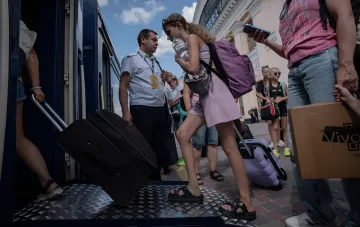
After the attack, further transfer was promptly organized for the passengers. With the assistance of Oleh Hryhorov, Head of the Sumy Regional Military Administration, and the regional military administration itself, buses were provided to deliver people to their destinations. According to the State Emergency Service of Ukraine (SESU), rescuers arrived at the scene, extinguished the fire, and simultaneously coordinated the evacuation: two SESU buses and two buses from local authorities were used to transport people. In total, according to the service, 90 passengers were evacuated. Community rescue officers also joined in organizing the work, coordinating actions and providing people with the necessary assistance.
Position of Ukrzaliznytsia and SESU
The company noted that "the enemy does not cease its attempts to cut off communications with frontline communities," and that the railway workers, in Pertsivskyi's words, "do not cease to travel boldly and to maintain such communications." Ukrzaliznytsia added that monitoring activities, the timely reaction of each passenger, and compliance with the train crew's commands "continue to save lives." SESU, for its part, reported that the fire following the drone strikes on the train was promptly extinguished, and that the evacuation of passengers was carried out by the rescue service and local authorities.
Contradictory data
Here the versions of the parties diverge. According to preliminary information from SESU and a statement by Ukrzaliznytsia, there were no casualties as a result of the attack — people were evacuated before the strikes were delivered. However, regional media (in particular, a report on glavred.info) state that in Sumy, under the drone attack, in addition to the train, a residential building was damaged and that there are casualties. Thus, the question of whether there are wounded and of the scale of the associated destruction in the city remains not fully resolved at the time of publication: official services describe the data as "preliminary" and record the absence of casualties among passengers, while the regional picture points to possible injuries and damage to civilian infrastructure. Until SESU provides clarification, the two versions should be regarded as consistent only in the fact of the attack itself, but divergent in terms of its consequences.
Context: a series of strikes on railways
The attack on the Kiev–Sumy train comes against the backdrop of Russia's ongoing attempts to disrupt railway communications with frontline territories. A reminder of this was the strike on the night of September 1, when the Russian army delivered a ballistic strike on Kiev's railway infrastructure: as a result, seven people were killed, including six Ukrzaliznytsia employees. The incident with the train in Sumy demonstrates that strikes on rail transport and communication hubs remain a persistent element of the campaign, and that Ukrzaliznytsia's monitoring teams have become a critical mechanism for reducing losses among passengers.