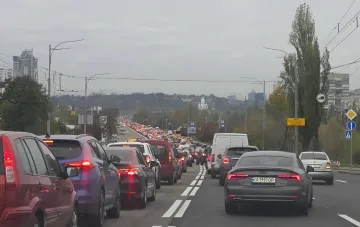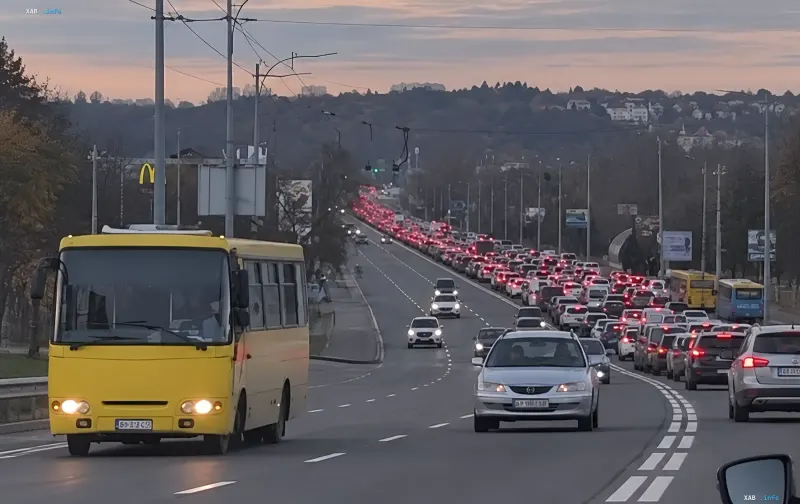
On Monday morning, November 16, Kyiv once again faced massive traffic jams that formed on the approaches to the bridges connecting the left and right banks. According to media reports, congestions were observed starting approximately at 07:30, and the number of vehicles on the roads continues to grow. The approaches to the Paton Bridge and Pivdennyi Bridge proved to be the most congested, with a large number of cars piling up, including on the public transport lane.
Morning Collapse at Key Crossings
Journalists captured the traffic situation in the direction of the Pivdennyi Bridge on video: columns of vehicles stretched for a considerable distance, and traffic on certain sections practically came to a halt. The dedicated public transport lane also turned out to be overloaded, indicating that passenger car drivers are attempting to bypass the traffic jams using all available lanes. Experts traditionally link the morning peak to the fact that the bulk of passengers are heading from the left bank to the right, where business and educational centers are concentrated.
Context: Bridges Remain in the Risk Zone
Against the backdrop of regular morning traffic jams in Kyiv, the issue of urban crossing safety is once again becoming urgent. We remind you that, according to available information, Russia has modernized Iskander missiles for more precise strikes on bridges, equipping them with optical and radar homing heads. According to Serhii "Flash" Beskrestnov, an advisor to the President of Ukraine, such systems were used during recent strikes on Kyiv bridges, making the crossings both transport arteries and high-risk objects.
Transport Restructuring: Temporary Routes
In parallel with the road collapse, the restructuring of public transport continues in the capital. Four new temporary trolleybus routes started operating in Kyiv on November 13. To avoid duplication, buses that previously repeated these directions were canceled, and two additional temporary bus routes were launched instead. Thus, the city authorities are trying to redistribute passenger traffic and reduce the load on overloaded road sections.
What This Means for Drivers
For motorists, the situation means that during morning hours, driving towards the Paton and Pivdennyi bridges, as well as traveling along dedicated lanes, remains the most difficult. Residents are advised to plan their routes in advance, take into account possible restrictions at the crossings, and, if possible, use public transport, including the new temporary trolleybus and bus routes operating since November 13.