
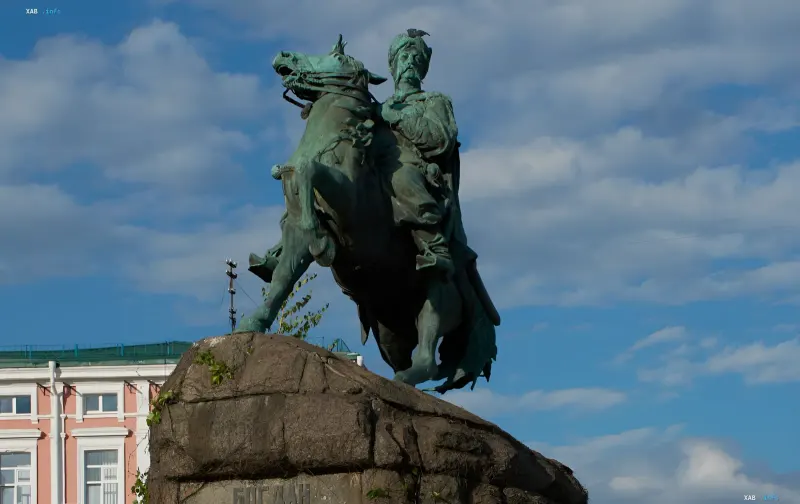
In the center of Kyiv, municipal services have completed the dismantling of metal protective structures that, for over four years, covered one of the capital's main symbols — the monument to Bohdan Khmelnytsky on Sofiivska Square. This was reported by Wave RBC.UA, citing a post by photographer Volodymyr Baidukov in Threads. The bronze equestrian composition, previously hidden under an armored framework, is now fully exposed and presents itself to Kyiv residents and city guests in its familiar, pre-war appearance.
Four years under 'armor'
The protective framework was installed after the start of the full-scale war, when the monument, along with several other cultural objects in the capital, found itself in a risk zone. The metal structure was intended to protect the monument from rocket and drone debris during Russian shelling of Kyiv. For more than four years, the sculpture remained under this protection, making it unrecognizable to residents accustomed to seeing the rider on a rearing horse in an open view.
Dismantling and restoration
Parallel to the removal of the protective framework, specialists worked directly on the monument itself. Vegetation had grown under the long-term protective cover and was cleared during the restoration work. Thus, the dismantling of the framework coincided with a comprehensive restoration of the monument: after the completion of the work, the monument looks neat and is fully accessible for viewing.
The history of one of Kyiv's most recognizable monuments
The monument to Bohdan Khmelnytsky is located in the very center of Sofiivska Square and is one of the most recognizable symbols of the city. The solemn opening of the composition took place in 1888. The bronze sculpture depicts the Hetman on a rearing horse — an image that for more than a century and a half has become an integral part of the urban landscape and the collective memory of Kyiv residents.
Return of the square to its pre-war appearance
The removal of the protective framework is part of a broader process of restoring the pre-war appearance of Sofiivska Square and other open spaces in the capital. As the immediate threat of shelling decreases, protective structures are gradually being dismantled, returning the city to its familiar look. For the residents of Kyiv, this is not only a technical but also a symbolic event: the return of the open monument is perceived as a sign of the normalization of everyday life in the city center.