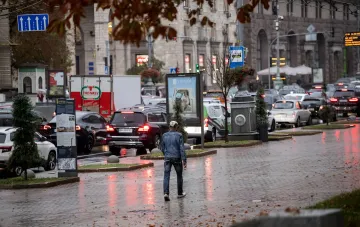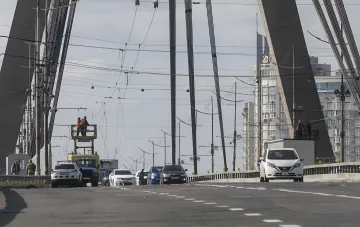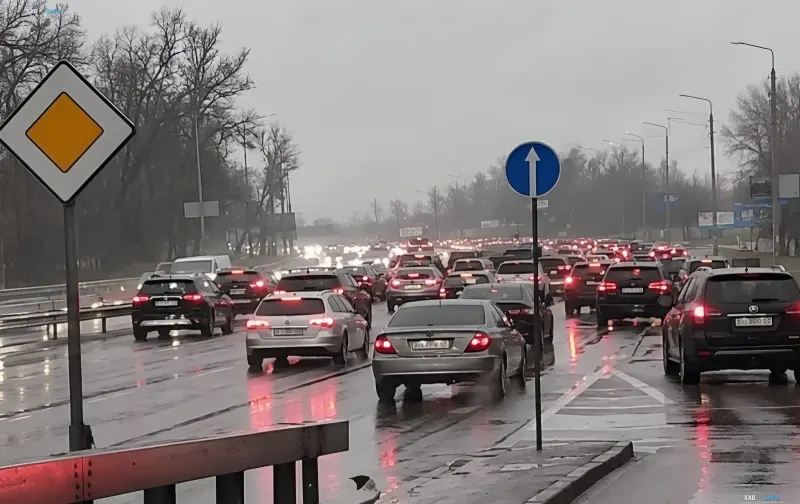
On the morning of November 18, Kyiv was paralyzed by multi-kilometer traffic jams. According to local chat groups citing residents, the densest congestion formed at European Square and near the Podilskyi Bridge, where traffic flows converge into the only available crossing points over the Dnipro River. The reason is the partial closure of the Pivnichi (Northern) and Pivdennyi (Southern) bridges, which were damaged as a result of a missile strike on the night of November 17. The road surface on both structures sustained damage, and city services introduced strict restrictions to ensure safety.
What is open and what is closed: Bridge traffic regime
The Northern Bridge operates under a restricted access mode: buses No. 21, 73, 101, and 114, trolleybuses, and special transport run across it in both directions. Passage is completely closed for passenger cars and transit freight trucks. The Southern Bridge is open in only one direction — from the left bank to the right bank. Vehicles weighing up to 10 tons and public transport weighing up to 18 tons, including buses No. 22-TD, 22-TL, and 91-T, are allowed to cross. In the opposite direction, from the right bank to the left bank, traffic on the Southern Bridge is not operating.
Alternative crossings and reversible lane
The Metro Bridge and Darnytskyi Bridge are open for normal car traffic. A reversible lane has been introduced on the Paton Bridge: from 06:00 to 16:00 it is directed toward the right bank, and from 16:00 to midnight — toward the left bank. This allows for flexible distribution of morning and evening traffic flows, but during rush hours the load on the remaining crossings increases sharply, generating multi-kilometer queues.
Metro and urban train: How to get between the banks
The green metro line (Syrets - Chervonyi Khutir) operates in a separated mode: trains do not cross the Dnipro River. Trains run separately on the "Syrets" — "Vydubychi" section and on the "Osokorky" — "Chervonyi Khutir" section. To bridge this gap, the city train is running 16 additional daily trips between the "Pochaina", "Darnytsia", and "Vydubychi" stations from November 18 to 20 — eight during the morning rush hour and eight in the evening. This is the main surface transit option to cross the river for passengers without a personal car.
Context: The attack on the night of November 17
The restrictions were introduced following the nighttime attack on November 17, during which Russian forces launched ballistic missiles at targets in Kyiv. According to data previously published by RBC-Ukraine, that night Russia attacked the entire country with missiles and 306 attack drones. Defense forces reported shooting down or suppressing 211 targets, while impacts were recorded at 44 locations. The damage to the bridge structures is precisely what caused the temporary restrictions on all crossings in the capital, which remain in effect on the morning of November 18.
City services recommend that drivers plan their routes in advance, take reversible lanes into account, and, if possible, use public transport or the urban train. Full restoration of traffic on the Northern and Southern bridges will only be possible after repair work is completed and the technical condition of the structures is assessed.