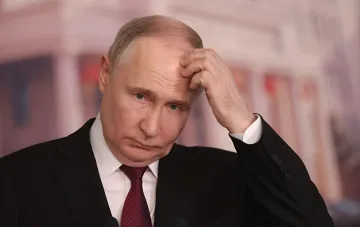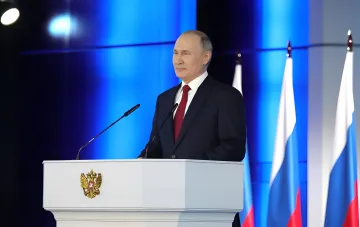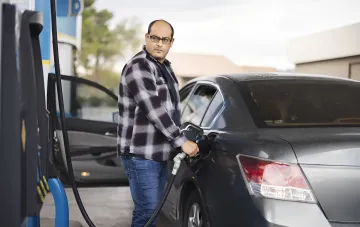
The authorities of Leningrad Oblast have decided to introduce a uniform limit on fuel dispensing at gas stations: from the nearest days, drivers will be sold no more than 30 liters of fuel per refueling. According to the regional government, this is a temporary measure, valid until October 1, 2026. RBC-Ukraine reports this, citing The Moscow Times. Governor Alexander Drozdenko, commenting on the situation, stated that it remains difficult, but the authorities hope to stabilize the market and called on residents not to panic.
How the limit will work and who will get priority
The 30-liter limit is planned to apply to all gas stations in the region. The authorities specifically provided that emergency services and ambulances will be able to refuel without a queue, so as not to disrupt the operation of critical infrastructure. At the same time, the 'even–odd' distribution mechanism (by the last digit of the license plate) has not been cancelled but kept as a reserve tool in case the situation worsens further. In fact, the 30-liter limit is the first stage of restrictions, which, by design of the officials, should smooth out panic demand and prevent the complete emptying of tanks at stations.
Closure of some gas stations and AI-95 shortage
Fuel problems in the region have already led to the suspension of some gas stations. According to Drozdenko, about 20% of private and small gas stations in Leningrad Oblast have stopped operating due to a lack of fuel, and the most acute difficulties arose precisely with AI-95 gasoline. This is confirmed by earlier reports: as late as the end of July 2026, the governor publicly named the number of closed stations near St. Petersburg, indicating a growing rather than one-off nature of the crisis. Introducing the limit is an attempt to prevent a complete collapse of the retail segment, when major chains are still operating while small stations remain without supplies.
The role of the KINEF refinery and strikes on oil refining
The key cause of the shortage was the shutdown of the KINEF oil refinery, one of the largest oil refining enterprises in northwestern Russia. Its disablement sharply reduced fuel supply in the adjacent regions, including Leningrad Oblast. Against this backdrop, on the night of September 15, 2026, the Ukrainian Defense Forces struck an oil refinery in Samara Oblast of the Russian Federation and the 'Atlant Aero' enterprise in Taganrog, and the consequences of a preliminary strike on the 'Slaviansk ECO' refinery have also been confirmed. Systemic strikes on oil refining infrastructure, according to observers, are forming a persistent shortage that regional authorities are trying to cope with through administrative restrictions.
Washington's reaction
The situation was also reacted to by the US president, who stated that Ukraine should stop striking Russian infrastructure, including oil refineries, since, in his words, this allegedly leads to a global diesel fuel shortage. This position underscores that the fuel crisis in certain regions of the Russian Federation has ceased to be an exclusively internal matter and has become an element of a broader discussion on the impact of strikes on energy infrastructure on global fuel markets.
Contradictory data
During fact-checking, a discrepancy in the geographic reference of the measure was found. The original text and the statements of Governor Drozdenko clearly point to Leningrad Oblast as the region where the 30-liter limit is introduced and where some gas stations have stopped. However, the headline of the RBC-Ukraine article (source 1) phrases the introduction of the limit as happening 'in Piter', i.e., in St. Petersburg. The editorial team notes this discrepancy: in one case it is a suburban region, in the other — a city of federal significance. In addition, source 2 (RBC, 29.07.2026) confirms the closure of gas stations 'near Petersburg' as early as July, which chronologically precedes the current September measures and indicates a phased development of the crisis. Until clarifications are received from the authorities, both versions of the geography are presented openly.