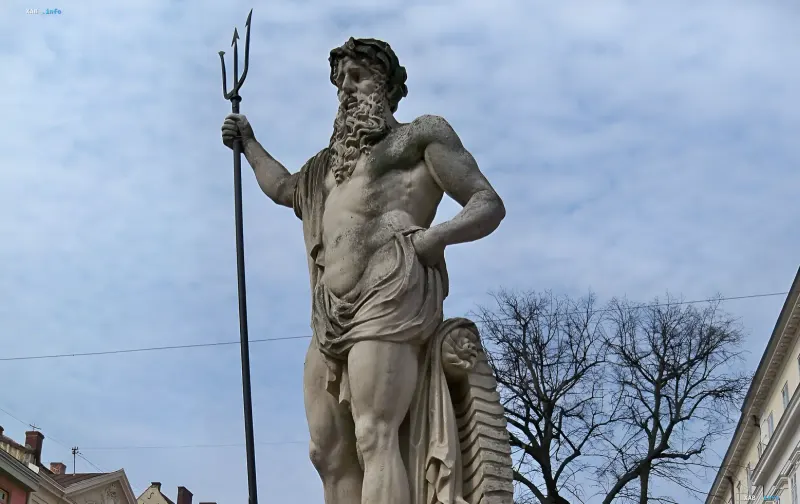
Damage to two historic sculptures adorning the fountains in Rynok Square has been recorded in the center of Lviv. The inspection was carried out by representatives of the Cultural Heritage Protection Office of the Lviv City Council together with invited restorers Oleh Rybchynskyi, Andriy Pochekva, and Yuriy Kochmar. The previous check of these monuments' condition was conducted two years ago, making this new review crucial for assessing the dynamics of stone degradation.
What experts recorded precisely
During the inspection, restorers documented the deepening of a crack on Neptune's hand holding the trident. According to their assessment, this damage creates a threat of further splitting of the stone fragment. Equally noticeable problems were found in the sculpture of Adonis: the hand holding the spear had detached from the figure even earlier. The damaged element along with the spear was dismantled and placed in storage until restoration begins. At the same time, specialists emphasized that overall they found no critical changes in the condition of the monuments compared to the previous inspection.
The main cause: Mistakes of past restorations
According to the experts' conclusions, the primary cause of the damage is linked to previous restorations. Specifically, during the restoration of the sculptures in 1982, Portland cement was used, which negatively affects limestone—the material from which the figures are made. Doctor of Architecture, Professor at Lviv Polytechnic Oleh Rybchynskyi explained that the use of cement led to moisture accumulation in the stone: due to temperature fluctuations, water expanded and gradually destroyed its structure. Additional factors included the natural impact of moisture and vibration from trams running through Rynok Square.
Protective structures have nothing to do with it
The restorers separately noted that the recorded damage is not related to the protective structures with which the sculptures were covered after the start of the full-scale Russian invasion. Additionally, experts pointed out that Adonis's hand, his spear, and head are not original parts of the sculpture: these elements were lost earlier and later recreated during restorations.
What's next: Winter preservation and restoration in 2027
Full-scale conservation and restoration work is planned to begin in 2027, as the current season is already coming to an end. For the near future, the main task has become the preservation of the sculptures during the winter and the preparation of a detailed restoration plan. After the inspection, Neptune and Adonis were covered again with protective structures. A separate restoration program is planned to be developed for each monument, prioritizing works and preparing estimates; the city will also consider attracting off-budget funding. Specialists from the Ivan Trush Lviv State College of Decorative and Applied Art are ready to join the project preparation.