On the night of September 22–23, 2026, Russia delivered one of the largest aerial strikes on Ukraine in recent times, employing attack assets from six geographic directions at once. According to the Ukrainian Air Force, as cited by RBC-Ukraine, the enemy launched 161 strike unmanned aerial vehicles, as well as three "Bandierol"/"Dane-T" type missiles. The attack began at 18:00 on September 22 and lasted for several hours, covering the territories of several regions, including the capital.
Scale of the attack and launch directions
Drones and missiles were launched from six points: from Orel, Kursk, Primorsko-Akhtarsk, Millerovo, as well as from the temporarily occupied territories — Donetsk and Hvardiiske in Crimea. Such a spread of directions indicates coordinated preparation of the strike at a level requiring the simultaneous deployment of forces from different strategic staging areas. Among the drones used, according to preliminary data, were jet-powered modifications of "Shaheds," "Gerbera"-type vehicles, and other models.
Air defense performance: 119 drones and three missiles shot down
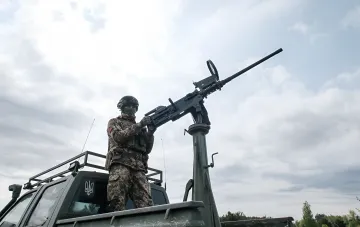
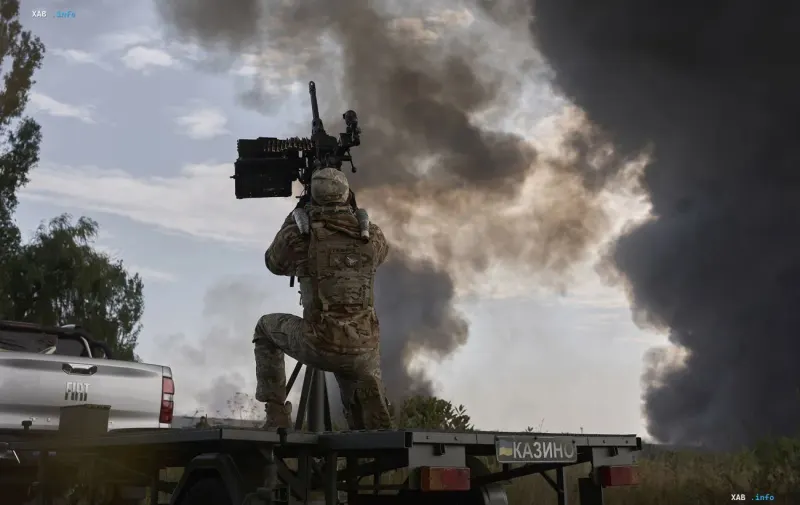
As of 08:00 on September 23, according to preliminary data from the Ukrainian Air Force, air defense forces shot down and suppressed 119 drones of various types, as well as all three "Bandierol"/"Dane-T" missiles. Thus, the interception rate was approximately 74% of the total number of UAVs launched. Nevertheless, impacts of aerial attack assets were recorded at 18 locations, and the fall of debris from shot-down drones was recorded at another 8 points. This means that a significant portion of the attacking vehicles either reached their targets or were shot down near populated areas.
Consequences in Kyiv and other regions
The capital of Ukraine was subjected to several waves of strikes this night. In the Holosiivskyi district of Kyiv, a drone hit warehouse facilities and a gas station, resulting in a fire. In the Solomianskyi district, fire engulfed the territory of a transport enterprise, and debris from shot-down drones fell between residential buildings. According to the BBC, 30 people were killed in Kyiv as a result of the strikes, however this figure had not been finally confirmed by Ukrainian authorities in the initial RBC-Ukraine reports at the time the material was prepared. Fires also broke out in several regions of Ukraine at the sites of impacts and falls.
Zelensky's warning before the strike
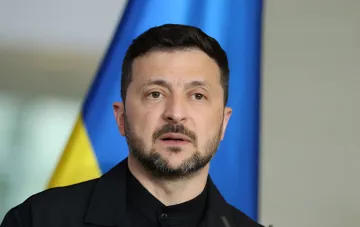
Even on the eve of the night attack, the President of Ukraine, Volodymyr Zelensky, publicly warned of the preparation of a new massive strike by Russia. According to him, Ukrainian intelligence recorded the corresponding preparations — the movement of equipment, the preparation of launch sites, and other signs of an imminent attack. This warning allowed air defense forces and civilian services to switch to a heightened state of readiness, which probably affected the final interception rate.
Contradictory data
The available sources contain discrepancies in the details. First, the initial RBC-Ukraine report, on which the main text relies, does not contain specific data on human casualties, whereas the BBC reports 30 killed in Kyiv. These figures may reflect different time snapshots: the RBC-Ukraine report was compiled as of 08:00, whereas the BBC data may have been updated later. Second, in the RBC-Ukraine text the strike is described as "nighttime," while the start time of the attack is given as 18:00 — effectively evening time. This may be due to the fact that the main phase of the strikes fell on the nighttime hours, while 18:00 was only the time of the first launches. In addition, the kp.ru source (ID 3) reports 292 UAVs shot down by the Ukrainian Air Force over the regions of Russia during the same period, which is a separate event and does not contradict but complements the picture of mutual attacks.