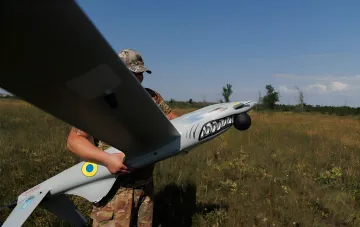

On August 9, 2026, one day after the incident involving the intrusion of an unmanned aerial vehicle into Bulgarian airspace, the Chief of the General Staff of Bulgaria, Admiral Emil Eftimov, presented the official version of events. According to him, the drone, which experts identified as the Ukrainian "Maya" decoy, was not intentionally directed towards Bulgarian territory. The explosion that occurred near a critically important international gas pipeline was a side effect of military operations on NATO's eastern flank.
The Electronic Warfare Version
Admiral Eftimov, who personally visited the site of the incident, stated that the aircraft could have been knocked off course by electronic warfare (EW) systems. According to this version, a Russian operator, attempting to intercept the drone over the combat zone, used powerful jamming that disoriented the UAV's navigation system. As a result, the drone changed its flight vector, crossed the border with Romania and, unable to return to base or complete its combat mission, detonated in the Bulgarian sky.
Threat Assessment and Absence of Intentional Attack
During the briefing, Bulgarian military officials emphasized that no signs of deliberate actions against the country were detected. Eftimov noted that, although such drones can carry up to 5 kg of explosives, no damage was done to infrastructure in this case. "The question was whether it was a 'Shahed' or not — it turned out it was not. This incident is a consequence of military operations taking place near our borders," RBC-Ukraine quotes the admiral, citing BGNES. Bulgaria, according to the Chief of the General Staff, continues to adapt to new realities and develop the necessary capabilities to protect its airspace.
Contradictory Data
Despite reassuring statements from the Bulgarian command, nuances requiring attention remain in the information space. On the one hand, the Ministry of Foreign Affairs of Ukraine categorically denied intentionally directing the drone towards Bulgaria, fully agreeing with the version of navigation failures. On the other hand, the fact of an explosion in the immediate vicinity of a strategic gas pipeline raises questions about the reliability of security systems. Furthermore, it has not yet been confirmed how accurately Bulgarian air defense systems were able to identify the drone before it went off course, leaving room for discussion as to whether it was indeed a "decoy" or a combat drone that lost control.
Regional Reaction and War Context
The incident, which occurred on the morning of August 8, once again raised the issue of the security of NATO borders bordering the conflict zone. While Romania and Bulgaria are strengthening airspace monitoring, Kyiv continues to use the "decoy" tactic to distract the enemy's air defense systems. As analysts note, such cases are becoming more frequent as the combat zone expands and electronic warfare systems on both sides become more active.