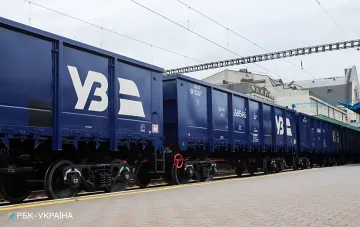
The Metallurgy Federation of Ukraine (MFU) has issued a public warning: further increases in Ukrzaliznytsia's freight tariffs could accelerate the decline in shipping volumes, halt industrial operations, and ultimately worsen the financial condition of the railway company itself. This is reported by RBC-Ukraine, citing a statement from the MFU. According to the Federation's assessment, the current tariff model creates a closed negative cycle in which every new step to raise rates only deepens the crisis of the carrier's cargo base.
"Death Spiral": How Fixed Costs Are Shifted onto Remaining Clients
The MFU describes the current situation as a "death spiral." The majority of Ukrzaliznytsia's expenses remain fixed and do not scale proportionally with shipping volumes. When cargo volumes decrease due to hostilities, the blockade of sea ports, and the general decline in industrial production, these invariable costs are redistributed among those clients who continue to ship products. As a result, the tariff rises, enterprises are forced to cut shipments, Ukrzaliznytsia's cargo base falls even further, and the need for the next rate increase arises. According to the Federation, starting August 1, 2026, freight tariffs have already risen by 30%, with an additional 15% increase scheduled for January 2027. Combined, this means an almost 50% increase over five months for enterprises that have simultaneously lost normal maritime logistics and operate under shelling conditions.
Crisis Figures: From 314 Million Tons to a Forecast of 130
For Ukrzaliznytsia to operate profitably, it needs to transport about 200 million tons of cargo per year. Meanwhile, the forecast for 2026 has already been adjusted from approximately 160 million to 130 million tons. For comparison: in 2021, before the full-scale war began, the railway transported 314 million tons. Citing calculations by the state enterprise Ukrpromvneshexpertiza, the MFU points out that a 37% tariff increase could reduce Ukrzaliznytsia's cargo base by 27 million tons annually. Potential losses for the economy are estimated at 96 billion hryvnias of GDP, 2.4 billion dollars in foreign exchange earnings, and 36 billion hryvnias in budget revenues per year. The Federation warns that if the dynamic does not change, Ukrzaliznytsia's cargo base could shrink to 120 million tons in 2027.
Metallurgy Is Already Paying for the Port Blockade
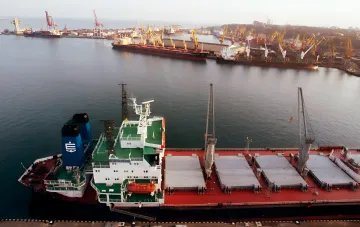
For the metallurgical sector, the consequences have become practical rather than hypothetical. Due to the port blockade and the August tariff increase, the cost of rail transportation of pig iron and raw materials for its production has grown from $30 to $68 per ton of finished products. Alternative logistics through ports in neighboring countries add another $46 per ton of pig iron. GMK Center analysts previously pointed out that further freight tariff increases amid the maritime export blockade could worsen the crisis in the mining and metallurgical complex while simultaneously degrading Ukrzaliznytsia's financial position. The MFU emphasizes: "We are not against Ukrzaliznytsia. We are for it to survive without destroying its clients."
Cross-Subsidization: The Passenger Segment Hits Freight Shippers
Metallurgists cite cross-subsidization of passenger transport at the expense of the freight segment as another systemic problem. According to the MFU, passenger transport losses amounted to about 20 billion hryvnias in 2025 and could exceed 25 billion hryvnias in 2026. The Federation believes these costs should be financed from the state budget under the European PSO (public service obligation) model rather than shifted onto freight shippers. "The state must realize that a tariff increase costs the budget more than direct support for Ukrzaliznytsia," the Federation notes. Earlier, ICC Ukraine also called for freezing Ukrzaliznytsia's freight tariffs until the end of martial law.
What Metallurgists Propose
The Metallurgy Federation of Ukraine puts forward a number of specific proposals: introducing preferential tariffs for enterprises located within 150–200 kilometers of the frontline, and ensuring the priority transit of critical metallurgical exports through the western border. The MFU summarizes: "We are finishing off our own exporters instead of saving them." Against the background of these statements, the issue of balancing Ukrzaliznytsia's tariff policy and maintaining the competitiveness of Ukrainian industrial exports remains one of the key issues for the country's economy in 2026–2027.