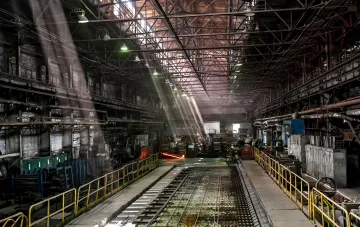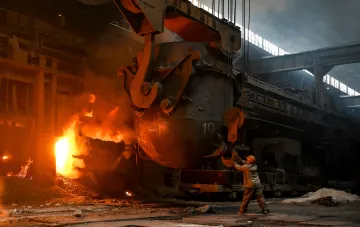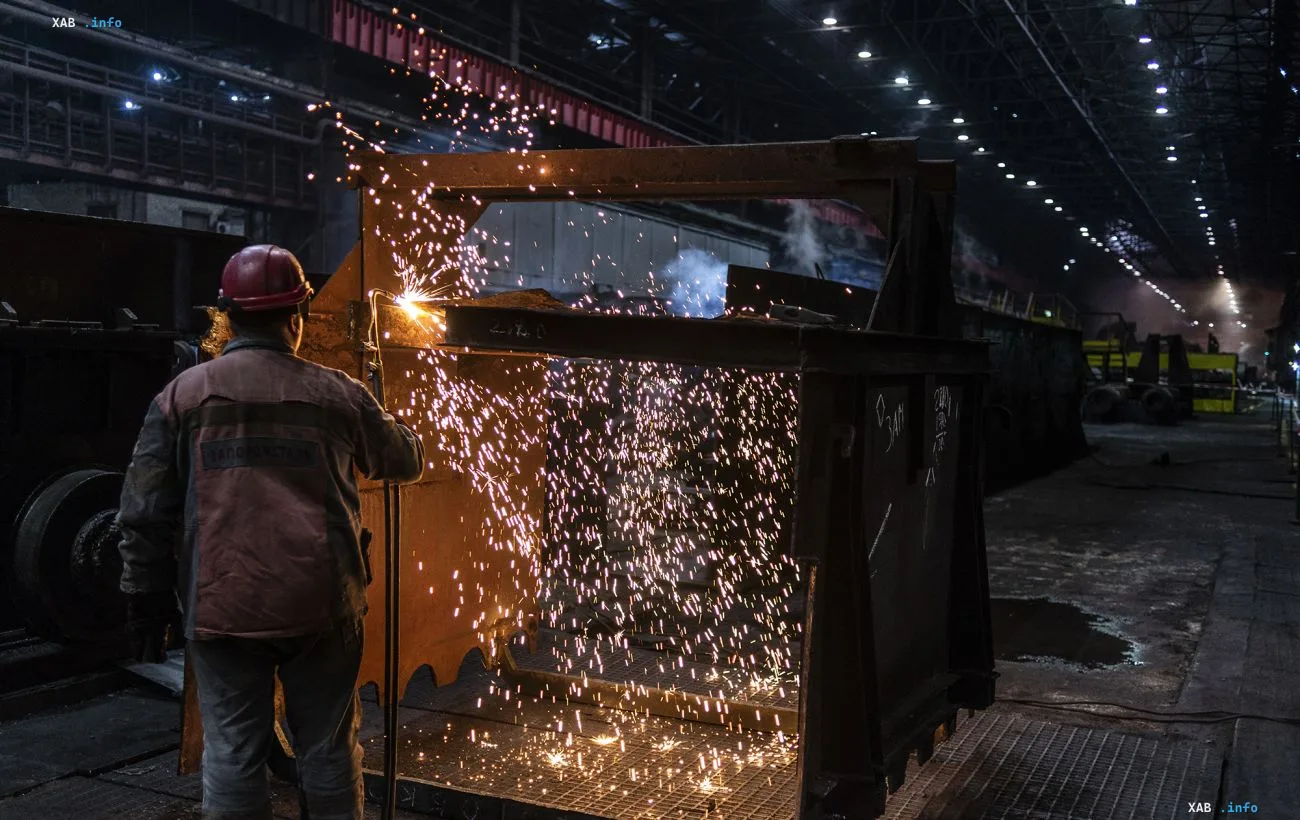
The Government of Ukraine has set an ambitious goal: to raise the share of the processing industry in GDP from the current 8.8% to 20%. This is a fundamental difference between an economy that sells raw materials and an economy that produces high-value-added goods, pays higher wages, and builds a sustainable tax base. However, as Maria Arshinnikova, GR Manager at ArcelorMittal Kryvyi Rih JSC, the largest segment of the processing industry — the mining and metallurgical complex (MMC) — is shrinking right now under the pressure of circumstances, most of which are external and independent of the quality of management at Ukrainian companies. Without a separate government decision on the metallurgical complex, the 20% goal may remain merely a declaration.
The Raw-Material Model and Its Physical Vulnerability
Over 35 years of independence, Ukraine has completed its transition to a raw-material economic model, and the war has fully exposed its vulnerability. When Russia blocked the Black Sea ports in 2022, the country effectively lost the ability to export the bulk of its output. The situation is repeating in its sharpest form today: with the blockade of the Greater Odesa ports, the NBU estimates total foreign-currency revenue losses in the second half of 2026 at approximately $2.5 billion. High-volume, low-margin export is critically dependent on the uninterrupted flow of the supply channel, whereas the processing industry is significantly more resilient to logistical crises.
The Fiscal and Social Weight of Metallurgy
In 2025, the processing industry became the largest taxpayer among all sectors of the economy, accounting for 18% of all receipts into the consolidated budget. In a country where security and defense spending is planned at more than a quarter of GDP, this is a direct link between a plant's operation and the financing of the army. The social multiplier is also significant: until February 2022, one MMC employee supported four jobs in adjacent sectors, and every thirteenth employed worker in Ukraine was connected to metallurgy. According to a World Bank estimate presented in the Ministry of Economy's presentation "Economy of the Future," restoring the damaged sectors requires about $524 billion, while Ukraine's total investment needs for 2026–2035 reach $770 billion. The greatest demand is for rebar, metal structures, pipe, cable, and cement. The question is only whether Ukraine will produce it.
CBAM and EU Tariff Quotas: a Double Blow to Exports
From 1 January 2026, the EU introduced the Carbon Border Adjustment Mechanism (CBAM) in full, with no exceptions or transition period for Ukraine. The consequences were immediate: in the first quarter, metallurgists lost more than 1.1 million tonnes of export orders from the EU, and certain product types lost 17% to 93% of their European exports. On top of an already high cost base, the cost of CBAM certificates for greenhouse-gas emissions was added. From 1 July 2026, the EU introduced a tariff-quota mechanism for steel imports — 18.3 million tonnes per year — with duties on out-of-quota supplies set at 50%. According to GMK Center estimates, by 2030 Ukraine could lose up to 2.1% of GDP: exports of long products and square billet may cease entirely, pig-iron production will fall by 75%, and flat products by 30%. Within two to three years, the operation of CBAM could lead to the closure of two of the country's four metallurgical plants.
The Energy Factor and Structural Degradation
Beyond trade barriers, metallurgy faces chronically high electricity costs — according to data published by Ukrainian media, tariffs for industrial consumers in Ukraine are three times the European average. This makes Ukrainian steel uncompetitive in domestic and external markets even before accounting for carbon charges. The dynamics of the complex's contraction are striking: in 2021, the MMC's contribution to the economy was 10.3% of GDP, its share in goods exports reached nearly 33% ($22.2 billion in foreign-currency revenue and about $3.5 billion in taxes and fees). By the end of 2024, the complex's contribution had shrunk to 7.2% of GDP, exports to $6.4 billion (15.4% of goods exports), and tax receipts to roughly $1 billion. The basis for these figures is obvious: a reduction in the production of core products.
Contradictory Data
Estimates of the scale of the threat cited by various sources do not always match in their level of detail. In Maria Arshinnikova's column, the talk is of the possible closure of two of the four metallurgical plants within two to three years of CBAM's operation. At the same time, the outlet UNIAN, citing industry media, reports that 72% of the country's steel production is at risk. These figures are not a direct contradiction — they reflect different metrics (the number of plants and the share of production volume), but the discrepancy in the perceived scale of the crisis deserves attention. Moreover, a significant part of the cited figures (the $2.5 billion loss estimate by the NBU, the GMK Center forecast of a 2.1% GDP loss, the World Bank data) are expert estimates and forecasts, not confirmed state statistics, which requires caution when citing them.
What Steps Can the State Take
In conditions where the industry simultaneously faces EU trade restrictions, high electricity costs, and a lack of decarbonization resources, the transition from a raw-material model to high-value-added production is impossible without state support. Within the discussion initiated by the industry, several directions are being considered: forming a separate government support plan for the MMC with clear instruments; subsidizing or compensating the cost of CBAM carbon certificates during a transition period; reducing the electricity tariff burden for energy-intensive production; creating a state decarbonization fund for metallurgy; and negotiating with the EU on individual quotas for Ukraine within the tariff-limitation mechanism. Without these steps, as the column's author emphasizes, the metallurgical complex risks becoming not the engine of the processing economy, but its first victim.